Showing posts with label history. Show all posts

Monday, 12 February 2018

Lego Classicist

Lego Classicist Logo
Lego Classicist is social media page which is dedicated to recreating classicists in Lego. Started up by Liam D. Jensen (Independent Historical Archivist) takes a interesting approach to history and Lego. 

Although every thing has a interesting beginnings. Lego Classicist started  up by  completely accident. During Liam's holiday break from work, he happened to be look online for Lego and stumbled across a number of figure parts that reminded him of Associate Professor Tom Hillard, an academic and an old family friend. He purchased the parts, thinking it would make a great gift.


The first Lego Classicist,
A/Prof. Tom Hillard.

Liam uploaded a photo of the figure on his personal Facebook account. The post became popular and found it's way across Australia.

After making more Lego figures for other academics, the hobby jumped started Lego Classicists.

The Lego Classicist family grow and now includes former Lego Senior Curator at Nicholson Museum Michael Turner (responsible for three Lego models displayed at the Nicholson Museum), Lego Prof. Wallace-Hadrill (Roman historian, archaeologist and TV presenter), Lego Dr. Kara Cooney (world renowned Egyptologist and presenter), Lego Sir Charles Nicholson (founder of the Nicholson Museum, University of Sydney) and Lego Prof. Christopher Smith (Director of the British School at Rome). 


Former Lego Senior
Curator at
Nicholson Museum,
Michael Turner
"The goal of these Lego Classicists figures is more metaphorical art than literally correct visual truth... so then the real challenge is not to make them 'look' like the person, but how to make them 'feel' like the person"
- L.D. Jensen

Every Lego figure made by Lego Classicistic are gifted to the people they portray and are never produced for commercial profit because every single figure to be unique and special to the person who are honoured in Lego Classicists. 

To qualify as an Lego Classicists, you need to come under the three categorise: 

Lego Sir Charles Nicholson
founder of the
Nicholson Museum
Lego Classicist
Anyone who deals with any other serious study of the ancient world of any other civilization across the world, such as Egyptology.

These include academic, scholar, archivist, librarian or historian who works in the study of classics (the ancient worlds of Greece & Rome, traditional classics) can become a Lego Classicist.


Honorary Lego Classicist
Anyone who works in the discipline of history, including modern history, who is promoting the greater use of the recording and use of history.

Anyone, including people outside the discipline of ancient & modern history, who has shown great interest in, or provided a significant new perspective to, the study or understanding of ancient history.

Me in Lego
by Lego Classicist
Honourable Mention Lego Classicist
Anyone who has had a connection to the work of ancient world study and engagement, even when their work is seemingly unconnected, but without whose help it would not be possible.

Lego Classicist reminds me a lot of myself, with my Lego historic people posts and photographs. I completely respect Liam for providing Lego figures for free in honour of those in the cultural sector.

Find out more:

Thursday, 23 November 2017

Lego Architecture - The Eiffel Tower

The Eiffel Tower
The Eiffel Tower is the most iconic structure in Paris, France. Named after the engineer, Gustave Eiffel, whose company designed and built the tower. 

In 1889 was the 100th anniversary of the French Revolution and Paris hosted a World's Fair to mark the occasion. Three years before, there was a competition to get a centrepiece for the exhibition. Gustave's plan for 985-foot tower won.   

The tower was a success with the public. By the end of the 1889 World's Fair, there had been nearly two million visitors. However, Eiffel only had a permit for twenty years; it was due to be dismantled in 1909, as the ownership reverted back to the city. The city was going to take it down, but Eiffel argued that the structure was valuable to communication and scientific purposes. '...not only the art of the modern engineer, but also the century of industry and science in which we are living' - Gustave Eiffel. After the short campaign, it was allowed to remain. 

Gustave Eiffel 
1832-1923
Eiffel installed a meteorology lab on the third floor and later constructed a wind tunnel at the foot of the tower. He carried out thousands of tests there and saw many others uses the tower to study meteorology, astronomy and physics.

The tower was home to the original wireless telegraphy which secured it's future. The top of the tower has been modified to a growing number of antennas. Now its now home to over 120 antennas plus a television mast making the tower 1,063 feet taller. 

Today the Eiffel Tower remains one of the most recognizable structures in the world, seeing estimated seven million people through the doors each year. 

The building of the Eiffel Tower

Tuesday, 21 February 2017

Adolf Hitler - The Monster and Tyrant

On the 20th April 1889 Adolf Hitler was born in a small town in Austria, Braunau am Inn. His father, Alois was a customs official while his mother, Klara, came from a poor family. Alois was a overbearing man and Adolf frequently found himself the wrong side of his anger. Adolf left school with no qualifications at 16. 

Hitler always dreamed of a career as a artist. He applied to the Vienna Academy of Fine Arts but was rejected in October 1907. He then moved to Vienna after the death of his parents and spent his time there sleeping in hostels and painting postcards. Here he developed many of his views of anti-semitism and desired to unite Germany and Austria.

Hitler in Vienna selling postcards
as a failed artist.
In 1913, Hitler moved to Munich to avoid military service. He loved Germany and wanted to prove his loyalty. In August 1914 he was given that chance, Hitler enlisted in the German army to be party of the Great War. He served in both France and Belgium, where he was decorated twice for bravery. In 1916, Hitler was wounded at the Somme. Then in 1918, he was wounded a second time after a gas attack. While in Pasewalk, Germany surrendered. The Kaiser Wilhelm II abdicated days before armistice and many of the members of parliament were given poisoned chalice. 

Hitler and many others were angry by what they saw as a betrayal by the Jews and the socialists at home. In June 1919, the Treaty of Versailles was signed and Germany were forced to accept sole responsibility for the war. As well as this, Germany had to pay a large amount of reparations and huge chunks of their territories were divided among the victors. Again like most, Hitler hated the treaty. He then decided to go into politics by joining the Germany Workers's Party (later known as the Nazi Party). Hitler completely agreed with their Nationalist and anti-semetic beliefs.


Hitler doing one of his
many hateful speeches.
Using his oratory skills, Hitler raised through the ranks of the Nazi Party. In February 1921, he spoke before 6,000 people in Munich.

Anton Drexler, founder of the Nazi Party, became unsettled by Hitler's popularity. He formed an alliance with a socialist party while Hitler was in Berlin. Drexler's attempt to undermine Hitler failed as he resigned and rejoined only when he was given control of the party in July 1921.

In 1923, the German Government was at the edge of collapse. The economic situation of the country was worsening as inflation increased. By that year a loaf of bread raised from 250 marks to 200 billion.

Wishing to see Germany to be great again under his control, Hitler encouraged revolution. On the 8th November, Bavarian Prime Minister Gustav Kahr addressed a collection of businessmen at a beer hall in Munich. Hitler and a load of his SA soldiers stormed in and forced Kahr to pledge his support. The next day Hitler led 3,000 men into the streets. However the police were waiting for them. Violence followed which resulted in the deaths of 16 Nazis and 3 policemen. Afterwards Hitler was arrested and sentenced to 5 years in prison for treason.


Hitler in prison writing
his book, Mein Kampf.
Within the 9 months of imprisonment in Bavarian fortress of Landsbury am Leck, Hitler spent his time writing his book, Mein Kampf. Mein Kampf outlines Hitler's views of the superiority of a white Aryan race and his cruel perspective for the Jews. He also describes Germans prosperity under Nazi control, for example, military expansion, elimination of the "impure" races and dictatorial authoritarianism. It was published in July 1925.

After being released he hoped to be elected. However, in 1928 the Nazis only won just 2.6% of votes.

Although, after the American stock exchanged collapsed in October 1929 and the foreign loans on which Germany relied on were stopped and repayment was called in. Unemployment rose to 6 million and parties on both sides saw support increase dramatically. That same year Hitler met 17 year-old Eva Braun, a German Catholic girl.

Hitler led the Nazis to become the largest party, with over 37% of the popular vote in the elections of July 1932. President von Hindenburg was concerned about the Communist's growing support. This persuaded him to give Hitler the post of Chancellor in January 1933. By March he was given dictatorial powers from the Enabling Act. This allowed him to pass laws without the Reichstag. Other Political parties, organisations and unions who were associated with the Nazis were disbanded.

The Army leaders were concerned with the SA who has helped Hitler to power. SA was considered as a group of thugs and Hitler needed to separate himself from them. In June 1934 the leader of the SA, Ernist Rohn and hundreds were assassinated in one night. This was to become known as the The Night of the Long Knives. Hitler couldn't tolerate opposition to his plans to suppress workers rights and make Germany ready for war. The army approved of his plans and when President Hindenburg died in August, they supported his promotion to Fuhrer.


The "Final Solution"
(the Holocaust) saw the death of
6 million Jews.
Since 1933 the Nazis had excluded the Jews and other "undesirables" from the public life. However, in September 1935, at the Nuremberg rally Hitler announced laws denying Jewish people citizenship and to marry or have sexual relations with people with German blood or decent. Hitler characterized the laws as an effort to achieve the "final solution". Under the new laws, Jews became targeted for persecution and was the direct course of the Night of Broken Glass. In November 1938 many Jewish residents and shops had their windows smashed and some were burnt down. Around 100 Jews were killed and thousands were arrested. From this time and on-wards huge numbers of Jews were around up and taken to concentration camps. Until the end of the conflict in 1945 over 6 million Jews were murdered within these camps by the SS. 

Hitler wished to see Germany great again and territorial expansion was part of achieving this. In March 1938, Hitler led his Nazi troops into Austria, achieving his dream to unify the two countries. Main countries, like Britain and France ignored Hitler's invasion at a attempt to prevent war. In September Neville Chamberlain (British Prime Minister) organised a conference in Munich and here all of Hitler's demands for Germany empire expansion was granted. Later that year Nazi troops marched into Czechoslovakia and took Sudetenland.


Hitler the looked east to Poland. Although before he could do anything he had to make a deal with Stalin's USSR. In late August 1939, the two powers agreed to a non-aggression pact. On 1st September the invasion of Poland began. Hitler was confident that Britain and France would not retaliate to help Poland. He was wrong, Britain and France declared war on 3rd September.


Poland was soon taken by Germany. Hitler's Blitzrieg tactics allowed the German army to take countries with a brutal single stroke. 

On 17th June 1940, France surrendered allowing Hitler to take revenge for the German defeat from two decades ago. Hitler ensured the French submitted at Compiegne in the same train carriage Germany had been forced to sign the Armistice which ended the First World War.


Churchill, Roosevelt & Stalin
making a alliance agreement. 
Despite the Nazi/Soviet Pact, Hitler hated the communists. Hitler was growing extremely suspicious of Stalin. Hitler planned to defeat and invade Western Europe before turning on the Soviet Union. However, when Soviet troops marched into Baltic States in 1941, Hitler decided to turn on them and invade the USSR. Hitler believed the Red Army would be defeated in a few months. He was wrong and to make it worst he declared war with another supper power, the US.

Hitler took control of the operations of the army in the Eastern-Front, convinced he was the only one to make the invasion successful. He directed the army from his headquarters which was thousands of miles away from the action. However, in February 1943, at Stalingrad, the German forces could not hold the city as they were outnumbered, freezing and starving. Hitler blamed the officers on the ground for ignoring orders. As he was the main person in command of the troops, he saw criticism for the first time because of the defeat.

Germany was losing control of the Eastern-Front. German forces retreated from Russia and in June 1944, the Allied forces landed in Normandy on D-Day. Hitler saw the invasion as a good thing and believed his forces could take the US and Britain out of the war.


The Wolf's Lair after
the 20th July Plot (Operation Valkyrie)
With the major turn of the success of the war was in favour of the Allies, many of Germany's loyal commanders now wanted Hitler dead to end the war for good and save lives. Hitler became increasingly paranoid as he had already had five attempts on his life. On 20th July 1944, saw the closest one yet. Hitler met with his military leaders at the Wolf's Lair Headquarters. Lieutenant Colonel Claus von Staufferberg left a bomb in a briefcase in the conference room. The blast killed three officers. However, Hitler escaped with minor injuries as he was shielded by the oak table which took much of the force of the explosion.  

In April 1945, the Soviet army were close to Berlin. Hitler excepted defeat. So he married Eva Braun, who had been his girlfriend for the last 11 years. They got married on the 29th April. The next day they both took a cyanide pill. Hitler then shot himself in the head. Their remains and two dogs were later discovered in his bunker by the Red Army. 

Saturday, 5 November 2016

Guy Fawkes - 'Remember, remember the Gunpowder Plot'

Guy Fawkes being arrested in 1603.
Guy Fawkes was born in April 1570 at York. He was brought up in a family and country of Protestants. However, he was Catholic and refused to attend Protestant services.

At the age of 21, Fawkes sold his estate and went to Europe to fight for Catholic Spain against the Protestant Dutch. In 1603 he was made captain. That same year he appealed to King Philip III of Spain to support a rebellion in England against James I. Philip refused to give his support.


While fighting for Spain at Flanders, Fawkes meet Thomas Wintour, who asked him to join a plot which would become known as the Gunpowder Plot.

After 18 months of planning, the plot failed when Fawkes was arrested at midnight on 4 November 1605 under the Houses of Lords. With him they found 36 barrels of gunpowder was found in a cellar directly below where the King would have sat to open Parliament the next day.

He was tortured for two days by James I's spymaster, Robert Cecil. After which, Fawkes confessed to it all. He was then sentenced to death - to be hanged, drawn and quartered. However, he jumped from the gallows, breaking his neck and so avoiding the horror of being cut down while still alive, having his testicles cut off and his stomach opened and his guts spilled out. His dead body was then hacked into quarters and his remains were sent to four corners of the Kingdom to serve as a warning.

Wednesday, 20 July 2016

The July Plot (Operation Valkyrie)

Lieutenant Colonel
Claus von Stauffenberg
1907-1944
The July Plot (or Operation Valkyrie) was a plan to assassinate the leader of Germany and the Nazi party, Adolf Hitler. The plan was to kill Hitler and then seize the state and replace the government with a new one to prevent destruction by the Allies by ending the war. The plot was planned and executed by a group of German military leaders who saw that Hitler was driving Germany to defeat. Even if they failed they wanted to show history that not all German's and army officers followed Hitler's beliefs and views blindly.

The leaders of the plot were Colonel General Ludwig Beck, former chief of the army general stuff, Colonel General Friedrich Olbricht and Major General Henning von Tresckow. 

However since 1933, there had been many attempts of assassination of Hitler by various groups. So Hitler became suspicious and was heavily guarded and often changed his schedule at short notice. 

The Wolf's Lair after the July Plot.
During a meeting at the Wolf's Lair with Hitler and more then 20 German officers and stuff, a bomb in a briefcase under the table went off during the meeting on the 20th July 1944. The briefcase was planted by Lieutenant Colonel Claus von Stauffenberg, the chief of staff of the reserve army. Stauffenberg said he had to make a phone call and left the room. Moments later the briefcase exploded which killed three officers. However, Hitler suffered only minor injuries.

After the bomb went off Stauffenberg believed Hitler was dead and flew to Berlin to start operation Valkyrie. Valkyrie was to use the reserve army to takeover the Nazi regime. Although, without confirmation of the death of Hitler the plan was at a standstill. General Friedrich Fromm, Commander of the reserve army and member of the plot, turned on his fellow conspirators to cover up his involvement, after he learned of the news that Hitler was still alive.

Stauffenberg and Olbricht
being shot on 21st July 1944.
Stauffenberg and Olbricht were arrested and shot on 21st July. Then hundreds of people who were suspected of being involved in the plot were arrested. Around 200 of them were executed. Tresckow committed suicide after he heard about the plot failed. Beck also committed suicide after he was arrested rather than stand trial. Erwin Rommel, a highly respected field marshal who was also linked to the plot, committed suicide to protect his family from facing a trial (as Rommel was a popular figure, the Nazis covered up the truth of his death and even gave him a state funeral). Fromm was shot in 1945 for his involvement. 

After the plot, Hitler believed it was fate he survived. "Having escaped death..." Hitler stated, "I am now more convinced that the great cause which I survive ... can be brought to a good end."   

On 30th April 1945, before Germany surrendered, Hitler committed suicide. The Wolf's Lair was blown up in January 1945 by the Soviet Army. I like to believe members of the July Plot ideas and beliefs to show not all Germans believed the same crazy views as Hitler.

Friday, 25 March 2016

Medieval Lego History book REVIEW!

Medieval Lego by Greyson.
Medieval Lego by Greyson Beights is one of the best Historic books which is illustrated with Lego I have ever read. The whole book inside and out just shows high quality in the information and materials. 

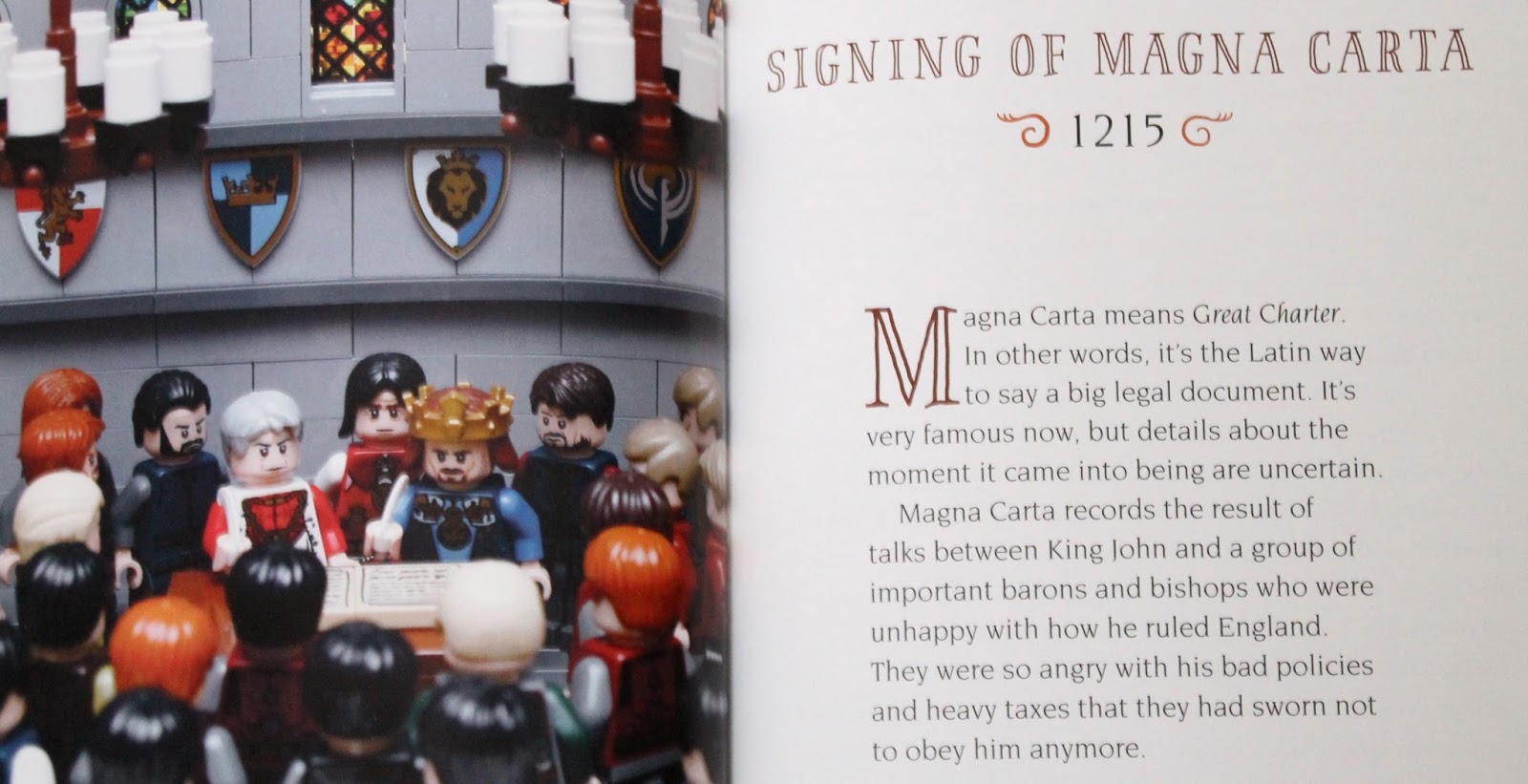
Greyson and with the help of Medievalist Scholars, created a book that looks at the overview of important events which made  the Medieval world as a whole. You'll will be able to learn about the Battle of Hastings, the signing of the Magna Carta and other great events. 

Greyson gives us a nice balance of Lego Photography and information, which you don't necessarily see in a lot Historic Lego books. Most of the time Historic Lego books give you a lot of photos with so little information accompanying them. This book however gives you a equal display of both.
  
Even the price seems generous for such a great  and small book. The only thing bad, that I can think of, is there isn't enough of it. Give me more! 

The photos themselves are great, everything you see is done in shot, as it seems there was no use of Photoshop at all. Oh and the builds that make up the scenery are amazing. Beautifully designed and built. 

Magna Carta 1215.
If you're a Lego purist then you would be happy to hear that everything in this book is Lego, no custom accessories or minifigs. Definitely a great book for both Lego and History fans of all ages.  

Tuesday, 9 February 2016

Martin Luther King, Jr. - "I Have A Dream!"

Martin Luther King
Martin Luther King, Jr. was born at Atlanta, Georgia on the 15 January 1929. Son to a Baptist minister, Martin Senior and a schoolteacher, Alberta Williams King.

In 1943, at the age of 14, King was forced to give up his bus seat for a white passenger on his ride home. This humiliating event in his life spurred him to confront the injustice of inequality.

In 1948, at the age of 15, King attended Morehouse College. Here he discovered the writings of Henry Thoreau and he became fascinated by his ideas of non-violent resistance. He was then inspired by father and college president, Benjamin Mays, a Baptist minister and advocate of racial equality. King was later ordained as a minister.

After he graduated college, King continued training at Crozer Theological Seminary in Pennsylvania and received his doctorate from Boston University School of Theology in 1995. King married Coretta Scott, a student at Boston on the 18 June 1953. Over the 10 years the couple had four children.

In December 1955, Rosa Parks was arrested in Montgomery for refusing to move from her seat on a bus so a white man could sit. King lead an African-American bus boycott that lasted 381 days. In 1956, the US Supreme Court ruled that Montgomery's bus policy was unconstitutional. 

Working with Bayard Rustin, a civil rights campaigner, King established the Southern Christian Leadership Conference (SCLC). King and the SCLC hoped to gain success in Montgomery by expanding the bus boycotts across the South. However, in some places, the African-American population was too small to make it effective. In other places, they quickly gave in on the demands of the boycott. Although elsewhere they simply allowed their bus services to go bankrupt, rather than give in to the boycotts.

In 1959, King traveled to India to learn more about Gandhi's non-violent protest movement. On his five week tour of India he met Gandhi's family and Prime Minister Nehru. He returned home determined to use non-violence in his protests. However, his non-violent protest in Albany, Georgia in 1961-1962 was unsuccessful as the police didn't confront the protesters and defused the situation by starving the cause of publicity.

In 1963, King staged a massive program of boycotting, marches and sit-ins at Birmingham, Alabama. As a result King was arrested on the 12 April. Although, at Albany, the authorities used violence to break-up protesters, using high-powered hoses and dogs. The coverage of the events won public support for King's case.

King was later released and was invited to the White House, where President Kennedy showed his support for the cause.

King made his iconic 'I Have A Dream' speech at the March on Washington for Jobs and Freedom on the 28 August 1963. There was a crowd of about 200,000 people at Lincoln Memorial and millions watching at home, as King shared his vision of the day of freedom and equality for all.

'I have a dream!'
On the 15 September 1963 a Supremacists bombed a Birmingham church and killed four girls. The was a huge public outcry at the news. At their funerals King addressed about 8,000 mourners. In the summer of 1964, Congress passed the Civil Rights Act, ending segregation in public. 

At 35, King received the Noble Peace Prize in 1964. Making him the youngest person to be awarded it.

In 1965, King started to campaign for voting rights in Selma, Alabama. After the state troops clashed with protesters at Edmund Pettus Bridge, activists around the country took part in a five day march from Selma to Montgomery. King led the group of 2,000 on the march. As they marched the grouped increased to 30,000. That August, the Voting Rights Act was passed, which removed the barriers for African-Americans to vote.

In 1966, King and his family moved to Chicago's west side black ghetto. He was trying to help the urban poor in North America. He found it hard to get the support behind his cause. Also the local authorities agreed to promote fair housing and then they went back on the promise. After this his message of using non-violence was losing support. Within many civil rights movements there was a growing support for violence. Which saw the rise of the Black Panther group. 

After his defeat in Chicago, King continued to involve himself in US economic, social and foreign affairs. On the 4 August 1967, he made a speech in New York at a march against the Vietnam War. He spoke against  the US's neglect of the poor and the waste of money on war.

In 1968, King started the Poor People's Campaign working to end economic inequality.

While in Memphis for a march, King was shot on his motel balcony by a white supremacist, James Ray, on the 4 August 1968. On hearing the news of his death, riots broke out across the country. President Johnson called for a national day of mourning.

Even though Martin Luther King, Jr. never saw his dream of peace and social equality in America, he is remembered for his beliefs, principles for non-violence, and views for freedom and equality. Today he is the only African-American to have a national holiday.  

Monday, 7 September 2015

Is Emperor Palpatine the NEW Julius Caesar?

Rise to power.
In light of new Star Wars film being released this year we thought we should do a post based on both the sci-fi film and history. So we are looking at a comparison of two characters, Julius Caesar and Emperor Palpatine. Please do put you opinions on the matter in the comments below. 

Emperor Palpatine, maybe a fictional character in one of the most famous sci-fi films of all time, Star War; but is there a real truth behind the fiction? As many people know that a lot of story writers take true stories and change them to make up their own fictional storylines. Now what I would like to do, is to see if this is the case for Palpatine and histories most famous figure, Julius Caesar. 


They both lived in a Republic which was started after the fall of a powerful dynasty, Roman Kings/Sith Lords. They both worked within the Senate of the Republic and both climbed the ladder of political ambition. With Caesar, he became Senator, then Quaestor in 69, Aedile in 65 and Praetor in 62. Then in 61-60 BCE he served as the governor of Spain and the Consulship in 59 BCE. And with Palpatine, he became Senator and them Supreme Chancellor. Both gaining the highest position in the Republic they served in and needing room to grow farther in power.


Both were clever enough to manipulate the situation they were in, for their own gain. With Caesar, he used the civil war that erupted between him and Pompey in 54 to be giving position of consul and dictator (at this time it was a elected position) of Roman in the time of crisis. After he defeated his enemy he refused to give up his power, and then forced the senate to give him the dictatorship for life in 44. 


With Palpatine, he was given 'emergency powers' in time of war with the Trade Federation and the Sith Lord, Count Dooku. After the Trade Federation and all the known Sith Lord were defeated, he refused to give up his powers when the Jedi Council requested him to do so. In doing so he revealed he was Darth Sidious, Dark Lord of the Sith. Both gained powers bestowed upon them by the Senate in time of crisis and both refused to give up that power after the threats were eliminated and no longer a problem.


The assassination.
In 44 BCE, after alienating the Roman senate, Caesar was assassinated in the Theatre of Pompey by many of the members of the senate, including his close friend Brutus. With Palpatine, he was killed by his padawan, Darth Vader. Both seem to have been killed by their friends because of one reason or another.


So it seems to be quite easy to say that the story of the Emperor Palpatine is very similar to that of Julius Caesar's. Through life and death, they seem to share the same path and plot. In conclusion, essentially the Star Wars character Emperor Palpatine is Caesar in more places than some. 

Thursday, 27 August 2015

Michelangelo - 'The true work of art is but a shadow of the divine perfection.'

Michelangelo (1475-1564)
Michelangelo Buonarroti was born on 6th March 1475 in Caprese, Italy. A few weeks after his birth his family moved to Florence.

In 1488 he became an apprentice to the painter Domenico Ghirlandaio. He then lived in the household of Lorenzo de' Medici, the leading patron of the arts and ruler of Florence. In 1496, the Medici were expelled from Florence, Michelangelo then travelled to Bologna and then Rome.In 1497, he was able to make a name for himself after his 'Pieta'. He then returned to Florence. Here produced one of his most famous pieces, 'David' 1501-1504.

He was recalled to Rome in 1505 by Pope Julius II to design Julius' tomb. However, the project was never completed because of quarrels between Julius and Michelangelo, and other projects he had going on at the sametime. Michelangelo was later commissioned to do the ceiling of the Sistine Chapel in the Vatican (1508-1512).

The new Pope, Leo X, commissioned Michelangelo to rebuild the facade of the church of San Lorenzo in Florence. However, it was later abandoned, but it was the beginning of Michelangelo's activities as a architect. Michelangelo also designed monuments to Giuliano and Lorenzo de Medici in the Medici Chapel in San Lorenzo. 

Michelangelo making
'David' 1501-1504
In 1534, Michelangelo returned to Rome, he was then commissioned to paint 'The Last Judgement' on the altar wall of the Sistine Chapel (1537-1541). In 1546 he worked on the great church of St. Peter's.

He the died in Rome on 18th February 1564.

Thursday, 13 August 2015

Lord Kitchener - Your Country Needs You!

Lord Kitchener
(1850-1916)
Horatio Kitchener was born on the 24th June 1850 in County Kerry, Ireland. He was educated in Switzerland and at the Royal Military Academy in Woolwich. 

In 1871 he joined the Royal Engineers. Between 1884-1885 he took part in a unsuccessful operation to relieve General Charles Gordon at Khartoum. In 1898 he was appointed Governor General of eastern Sudan. In 1898 he was made Governor of Sudan after he succeed in the reoccupation of Khartoum.

In 1900 he was appointed chief of staff to Lord Roberts, the commander of the Boer War. Kitchener later had to deal with the Boer resistance after Roberts was recalled back to England. The one of the measures he put in place was the use of a civilian prison camp - the first ever use of the term 'Concentration Camp'.


Lego Lord Kitchener's
enlistment poster.
In 1902 after he returned to England, he was made Viscount and Commander-In-Chief of India. In 1911 he became proconsul of Egypt, served there and in Sudan until 1914. In 1914 he was appointed Earl, before war broke out. He was then made Secretary of State for War. Unlike many others, Kitchener saw that the war was likely to last for years, so he started to enlist and train huge numbers of volunteers. 

As many of his cabinet colleagues did not share is warship ideas, he was relieved of his responsibilities. He later lost further reputation over his support of the failed Dardanelles operation and the 'Shell Crisis' of 1915. 

On the 5th June 1916 he drowned, when his ship, HMS Hampshire was sunk by a mine near the Orkney Islands, on his way to Russia on a mission.

Wednesday, 29 July 2015

Charlie Chaplin - "A day without laughter is a day wasted."

"A day without laughter
 is a day wasted." - Chaplin
Charlie Chaplin was born in Walworth, London on 16th August 1889. His parents were Hannah Harriet Pedlingham and Charles Chaplin. They were both music performers and later separated to seek their careers. Chaplin stayed with his mother, who lost her career. Chaplin spent most of his life in and out of charity homes and workhouses, between his mother's insanity bouts. His mother was later committed to Cane Hill Asylum in May 1903.

At age 8, Chaplin started his acting career by touring with the Eight Lancashire Lads. At 18 he toured with Fred Karno's Vaudeville Troupe, and joined them on their US tour in 1910.

He travelled to California in December 1913 and signed with Keystone Studios' Comedy Director, Mack Sennett. While at Keystone, Chaplin appeared in and directed 35 films. In November 1914, he left Keystone and signed on at Essanay, where he made 15 films. In 1916, he signed with Mutual and made 12 films. In June 1917, Chaplin signed with First National Studios, after this he built Chaplin Studios. And in 1919, he and other actors formed the UA (United Artists). 

In 1921, Chaplin was decorated by the French government for his work as a filmmaker, and appointed as Officer of the Legion of Honor in 1952. In 1972, he was honoured with an Academy Award. In 1975, he was created Knight Commander of the Order of the British Empire in the New Year's Honours List.


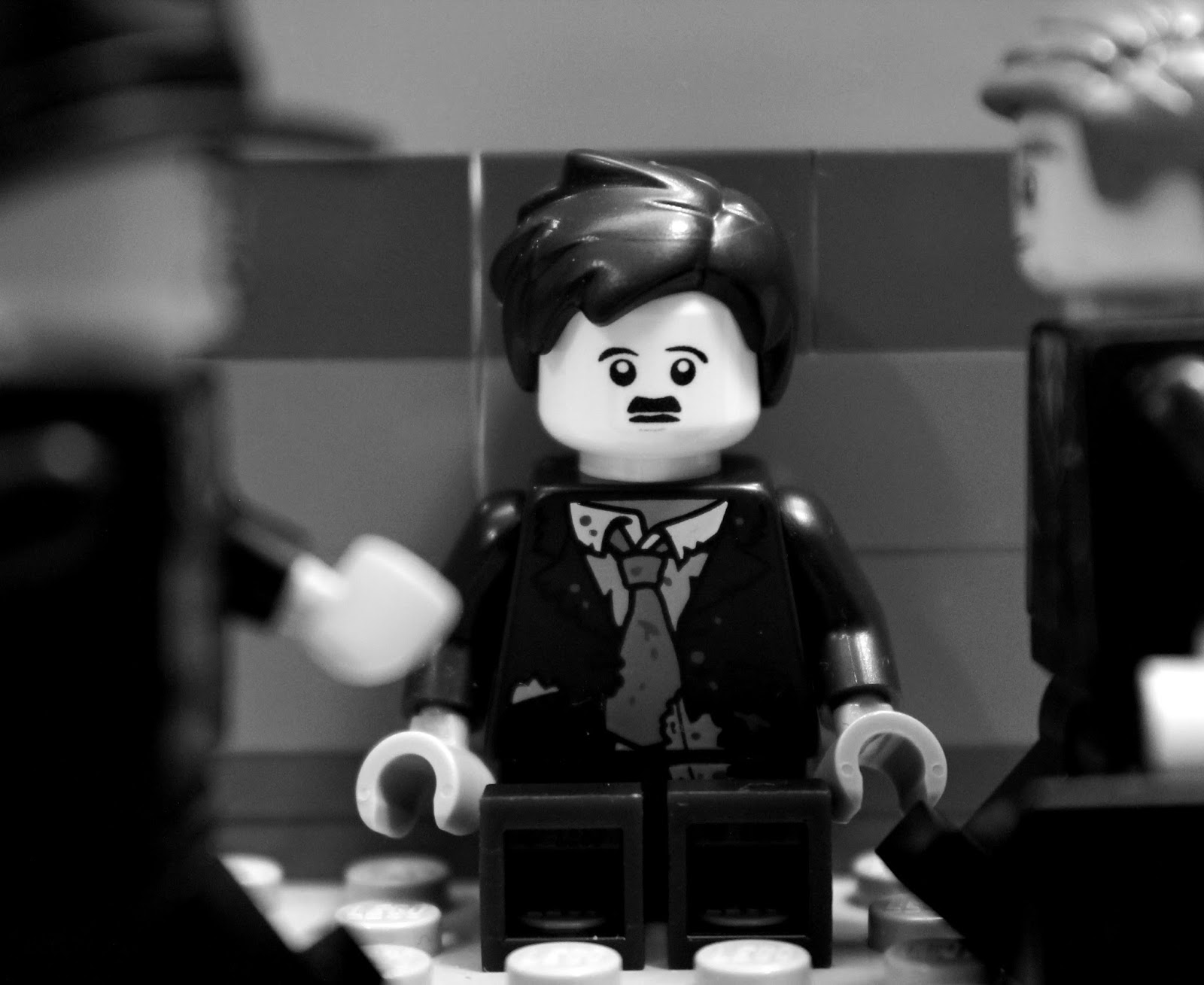
Chaplin as Hitler
in The Great Dictator (1940)
Although, with great success comes great scandal and controversy. During the First World War, he had his loyalty to England questioned. As he never applied for US citizenship. Many British called Chaplin a coward and a slacker. This all sparked suspicions with the FBI, who believed he was using a Communist propaganda into his films. In Chaplin's film The Great Dictator, in 1940, where he played a humous Adolf Hitler, this film stirred up further suspicions and dislike towards him.

Chaplin was later shunned for his support for aiding the Russian struggle against the Nazis during the Second World War. The US government questioned his morals and political views, and suspected him of having Communist ties. When Chaplin and his family travelled to London for the premier of Limelight (1952), he was denied re-entry to the US. He decided to settle in Switzerland. Where he died of natural causes on 25th December 1977 at his home. Although, in 1978 his corpse was stolen from his grave and not recovered for 3 months, he was re-buried in a concrete vault.

Thursday, 16 July 2015

Alexander the Great "There is nothing impossible to him who tries."

Alexander the Great
(356-145 BCE)
Alexander was born in Pella, the Capital of Macedonia in July 356 BCE. His parents were Philip II of Macedon and Olympias. He was educated by the Philosopher Aristotle. 

His father was assassinated in 336 BCE and Alexander became Alexander III of Macedon. After Alexander dealt with the problems in Macedon and reasserted Macedonian power within Hellas (Greece). He set out to conquer the Persian Empire. 

Against the odds, he led his army to victories across Persian territories of Asia Minor, Syria and Egypt, without any defeat. In 331 BCE, the young Alexander was able to achieve being King of Macedonia, leader of Hellenes (Greeks), overlord of Asia Minor and Pharaoh of Egypt became 'Great King' of Persia at the age of 25.


There is nothing impossible
to him who tries.
- Alexander
Within the next 8 years, Alexander led his army a further 11,000 miles, discovering over 70 cities and creating an empire over 3 continents, which were linked by a international network of trade and commerce. All this was united under the Hellenes language and culture, while adapted within individual customs in order to rule millions.

However, Alexander died of a fever in Babylon on June 323 BCE. His death sparked a huge power struggle. Macedonia had a bloody civil war with those who wished for control of the Empire. Hellas rebelled against Macedonia and expelled them from Hellas. The Macedonian Empire was eventually split into main kingdoms and with the rise of Rome ended the Macedonian kingdom when both Macedonia and Hellas were conquered in 167/145 BCE.

Thursday, 25 June 2015

Leonidas I and the 300 Spartans

King Leonidas I
(530-480 BCE)
Leonidas I was the son of the Spartan King Anaxandrides. He became king after the death of his older half-brother Cleomenes I in 490 BCE.

As a male Leonidas, went through mental and physical training. From childhood every Spartan boy goes through their horrible education system, the Agoge, in preparation to become a warrior for Sparta. Once in the Spartan forces they would become a Hoplite, a soldier armed with a round shield, spear and a iron short sword. The Hoplites form in a battle a phalanx, rows of hoplites stood directly next to each other making a wall of shields and spears. During a frontal attack, this wall provided significant protection to the warriors behind it. Although if the formation broke or the enemy attacked from the sides or the rear then the formation became useless. 


Ancient Hellas (Greece) was made up of several hundred City-States. Although most were divided they banded together to defend Hellas from a foreign invader, Persia. In 490 BCE the Persian King Darius I instigated an attempted a invasion, but a combined Hellenes (Greeks) force pushed back the Persian army at the Battle of Marathon. 

In 480 BCE, one of Darius' sons, Xerxes I, attempted an invasion of Hellas. Under Xerxes, the Persian army moved through the Hellas eastern coast, with the Persian navy moving parallel to the shore. To reach the lower half of Hellas the Persian's had to go through the coastal pass of Thermopylae.


Battle of Thermopylae 480 BCE
In the late summer of 480, Leonidas led 300 Spartans and 6,700 Hellenes forces in attempted to stop the Persians through the narrow pass. For two days the Hellenes defended the attacks of the numerous enemy. Although the Persians found a route over the mountains to the west, enabling them to surround the Hellenes forces. Most of the Hellenes forces fled rather then see certain death. Only an army of Spartans, Thespians and Thebans remained and all of them were slaughtered. The Persians found and beheaded Leonidas' corpse, insulting him by denying funerary rights.

After the Battle of Thermopylae, the Athenian navy defeated the Persians at the Battle of Salamis, sending the Persians back home. It took forty years before Sparta retrieved Leonidas' remains to bury him as well as having a shrine built in his honour.   

Saturday, 13 June 2015

Mohandas Gandhi - "We shall either free India or die in the attempt..."

Lego Gandhi,
the lawyer, 1893.

(1869-1948)
On 2nd October 1869 in North West India, Mohandas Karamchand Gandhi was born in the State of Porbandar. His father worked in government as the Chief Minister of Porbandar. His mother was a strong Hindu, vegetarian. At the age of 13, Gandhi married Kasturba in 1883. 

In 1888, Gandhi was given a chance to study law at the Inner Temple in London. He moved to London and he became acquainted with Western clothing. He later joined a vegetarian movement and at the Theosophical Society helped him with traditional Hindu principals - Vegetarianism, no alcohol and sexual abstinence.

In 1893 Gandhi returned to India to practise as a lawyer but after he lost his first case, he was thrown out of office. Humiliated, Gandhi accepted a post in South Africa. When travelling across the country in a first class train carriage, he was removed because of his race. Appalled at his treatment of the Indians. So he started up a Indian Congress in Natal to fight racism using non-violent civil protests. He then took a vow of celibacy and began wearing the traditional white Indian dhoti robe.

In 1914, he lead 2,221 people from the working Indian classes on a march from Natal to Transvaal in an act of public disobedience against a £3 taxon people of Indian descent. Gandhi was arrested and sentenced to 9 months imprisonment but the strike spread and the British were forced to drop the tax and release Gandhi. 

Later in 1915, Gandhi returned to India. He was shocked at the overcrowding and poverty he encountered. Gandhi called for a day of protest against the Rowlatt Act which allowed the imprisonment of anyone who was suspected of terrorism. Thousands gathered in several cities but the protesters turned violent. In Amritsar, the military fired upon 20,000 protesters. About 400 where killed and 1,300 were wounded. After the massacre, Gandhi started to campaign for Indian Independence. 

"I wear the national dress 
because it is the most natural 
and the most becoming 
for an Indian." - Gandhi
In 1921, Gandhi became the leader of the Indian National Congress and campaigns for political independence from Britain. In response the British arrested Gandhi for sedition and he was imprisoned for 2 years.

In 1930, the British planned a conference in London to discuss India's future. They refused to allow any Indian presents in the talks to put their own opinions across. In retaliation to this, Gandhi started a campaign against Britain's Salt Laws, which outlawed Indians from collecting or selling salt and forced to pay heavily taxed British salt. He lead thousands on a 'March to the Sea' where the protesters boiled the Sea water to make illegal salt. Gandhi was arrested and the protest escalated, thousands refused to pay their taxes and rent. The British gave in and Gandhi was released and was allowed to go to London for the conference.

In 1931, Gandhi travelled to London for the Round Table Conference as a representative of the Indian National Congress. However, the British weren't ready to grant India Independence. They believed that Gandhi didn't have the whole of India's interests at heart. Despite the loss, Gandhi was allowed an audience with King George V and he visited mill workers at Lancashire. After his failure at the conference, Gandhi stepped down as leader of the Indian National Congress. 

"We shall either free India
or die in the attempt" - Gandhi
In 1942, Winston Churchill called on India for support in the war against Germany. Gandhi disliked the idea of sending Indian aid to the British, while India was subjugated by them. Gandhi planned a non-violent protest demanding the British to 'Quit India'. In response, Gandhi and his wife was imprisoned. A string of violent protests for Gandhi's release erupted across India. He was released in 1944 but his wife died months before.

In 1947, Britain began negotiations for the independence of India. The Mountbatten Plan outlined the formation of the two new independent states of India and Pakistan, divided along the religious region divide. Gandhi's vision of a united India and religion was destroyed. The state partition started mass killings and the migration of millions. Gandhi leafed Delhi and travelled to Calcutta in hope of settling the violence.

In 1948, Gandhi returned to Delhi to protect Muslims who stayed in India. However, on his way to prayer at Birla House he was shot dead by a Hindu extremist.