Showing posts with label World War 2. Show all posts

Tuesday, 21 February 2017

Adolf Hitler - The Monster and Tyrant

On the 20th April 1889 Adolf Hitler was born in a small town in Austria, Braunau am Inn. His father, Alois was a customs official while his mother, Klara, came from a poor family. Alois was a overbearing man and Adolf frequently found himself the wrong side of his anger. Adolf left school with no qualifications at 16. 

Hitler always dreamed of a career as a artist. He applied to the Vienna Academy of Fine Arts but was rejected in October 1907. He then moved to Vienna after the death of his parents and spent his time there sleeping in hostels and painting postcards. Here he developed many of his views of anti-semitism and desired to unite Germany and Austria.
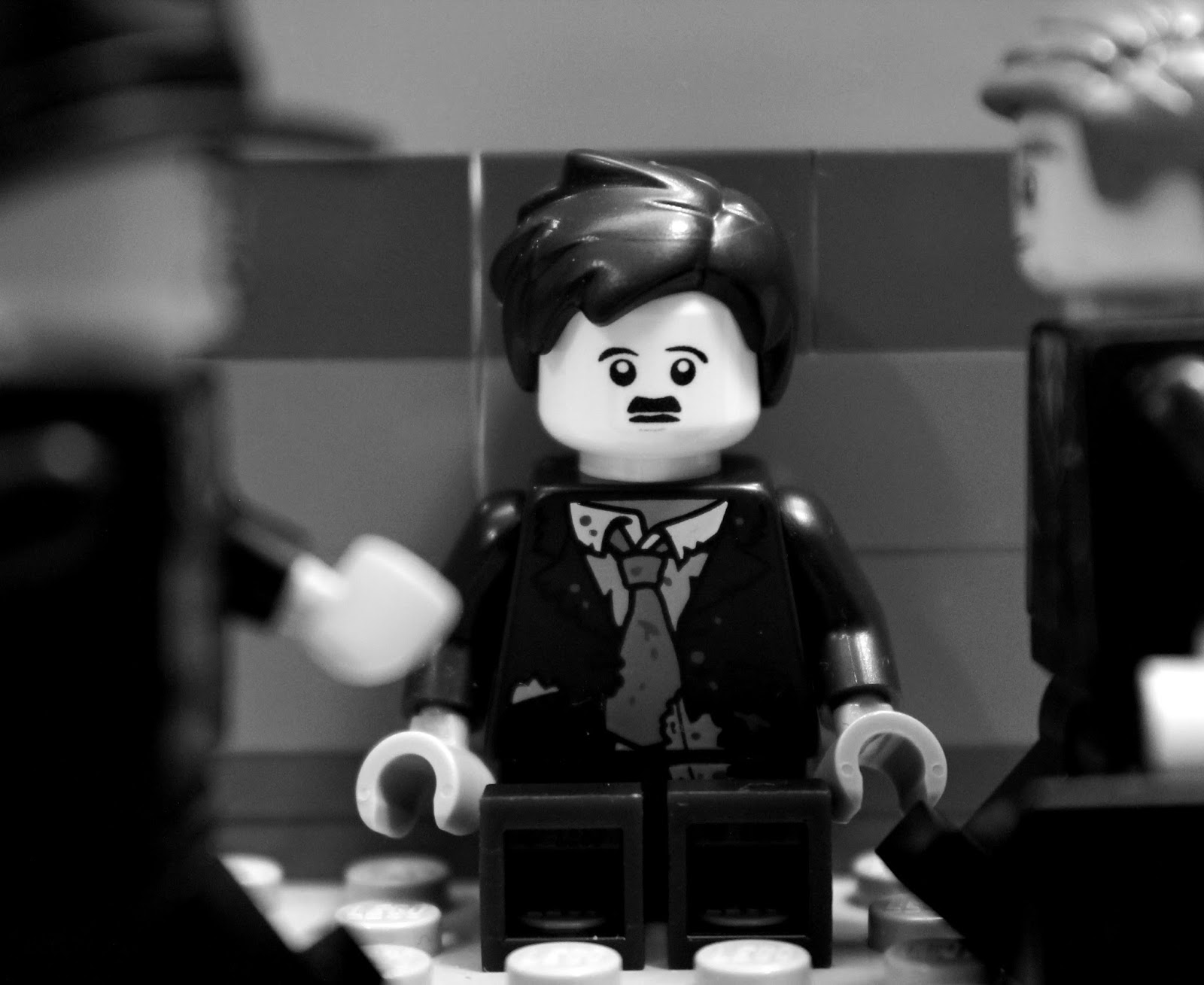
Hitler in Vienna selling postcards
as a failed artist.
In 1913, Hitler moved to Munich to avoid military service. He loved Germany and wanted to prove his loyalty. In August 1914 he was given that chance, Hitler enlisted in the German army to be party of the Great War. He served in both France and Belgium, where he was decorated twice for bravery. In 1916, Hitler was wounded at the Somme. Then in 1918, he was wounded a second time after a gas attack. While in Pasewalk, Germany surrendered. The Kaiser Wilhelm II abdicated days before armistice and many of the members of parliament were given poisoned chalice. 

Hitler and many others were angry by what they saw as a betrayal by the Jews and the socialists at home. In June 1919, the Treaty of Versailles was signed and Germany were forced to accept sole responsibility for the war. As well as this, Germany had to pay a large amount of reparations and huge chunks of their territories were divided among the victors. Again like most, Hitler hated the treaty. He then decided to go into politics by joining the Germany Workers's Party (later known as the Nazi Party). Hitler completely agreed with their Nationalist and anti-semetic beliefs.


Hitler doing one of his
many hateful speeches.
Using his oratory skills, Hitler raised through the ranks of the Nazi Party. In February 1921, he spoke before 6,000 people in Munich.

Anton Drexler, founder of the Nazi Party, became unsettled by Hitler's popularity. He formed an alliance with a socialist party while Hitler was in Berlin. Drexler's attempt to undermine Hitler failed as he resigned and rejoined only when he was given control of the party in July 1921.

In 1923, the German Government was at the edge of collapse. The economic situation of the country was worsening as inflation increased. By that year a loaf of bread raised from 250 marks to 200 billion.

Wishing to see Germany to be great again under his control, Hitler encouraged revolution. On the 8th November, Bavarian Prime Minister Gustav Kahr addressed a collection of businessmen at a beer hall in Munich. Hitler and a load of his SA soldiers stormed in and forced Kahr to pledge his support. The next day Hitler led 3,000 men into the streets. However the police were waiting for them. Violence followed which resulted in the deaths of 16 Nazis and 3 policemen. Afterwards Hitler was arrested and sentenced to 5 years in prison for treason.


Hitler in prison writing
his book, Mein Kampf.
Within the 9 months of imprisonment in Bavarian fortress of Landsbury am Leck, Hitler spent his time writing his book, Mein Kampf. Mein Kampf outlines Hitler's views of the superiority of a white Aryan race and his cruel perspective for the Jews. He also describes Germans prosperity under Nazi control, for example, military expansion, elimination of the "impure" races and dictatorial authoritarianism. It was published in July 1925.

After being released he hoped to be elected. However, in 1928 the Nazis only won just 2.6% of votes.

Although, after the American stock exchanged collapsed in October 1929 and the foreign loans on which Germany relied on were stopped and repayment was called in. Unemployment rose to 6 million and parties on both sides saw support increase dramatically. That same year Hitler met 17 year-old Eva Braun, a German Catholic girl.

Hitler led the Nazis to become the largest party, with over 37% of the popular vote in the elections of July 1932. President von Hindenburg was concerned about the Communist's growing support. This persuaded him to give Hitler the post of Chancellor in January 1933. By March he was given dictatorial powers from the Enabling Act. This allowed him to pass laws without the Reichstag. Other Political parties, organisations and unions who were associated with the Nazis were disbanded.

The Army leaders were concerned with the SA who has helped Hitler to power. SA was considered as a group of thugs and Hitler needed to separate himself from them. In June 1934 the leader of the SA, Ernist Rohn and hundreds were assassinated in one night. This was to become known as the The Night of the Long Knives. Hitler couldn't tolerate opposition to his plans to suppress workers rights and make Germany ready for war. The army approved of his plans and when President Hindenburg died in August, they supported his promotion to Fuhrer.


The "Final Solution"
(the Holocaust) saw the death of
6 million Jews.
Since 1933 the Nazis had excluded the Jews and other "undesirables" from the public life. However, in September 1935, at the Nuremberg rally Hitler announced laws denying Jewish people citizenship and to marry or have sexual relations with people with German blood or decent. Hitler characterized the laws as an effort to achieve the "final solution". Under the new laws, Jews became targeted for persecution and was the direct course of the Night of Broken Glass. In November 1938 many Jewish residents and shops had their windows smashed and some were burnt down. Around 100 Jews were killed and thousands were arrested. From this time and on-wards huge numbers of Jews were around up and taken to concentration camps. Until the end of the conflict in 1945 over 6 million Jews were murdered within these camps by the SS. 

Hitler wished to see Germany great again and territorial expansion was part of achieving this. In March 1938, Hitler led his Nazi troops into Austria, achieving his dream to unify the two countries. Main countries, like Britain and France ignored Hitler's invasion at a attempt to prevent war. In September Neville Chamberlain (British Prime Minister) organised a conference in Munich and here all of Hitler's demands for Germany empire expansion was granted. Later that year Nazi troops marched into Czechoslovakia and took Sudetenland.


Hitler the looked east to Poland. Although before he could do anything he had to make a deal with Stalin's USSR. In late August 1939, the two powers agreed to a non-aggression pact. On 1st September the invasion of Poland began. Hitler was confident that Britain and France would not retaliate to help Poland. He was wrong, Britain and France declared war on 3rd September.


Poland was soon taken by Germany. Hitler's Blitzrieg tactics allowed the German army to take countries with a brutal single stroke. 

On 17th June 1940, France surrendered allowing Hitler to take revenge for the German defeat from two decades ago. Hitler ensured the French submitted at Compiegne in the same train carriage Germany had been forced to sign the Armistice which ended the First World War.


Churchill, Roosevelt & Stalin
making a alliance agreement. 
Despite the Nazi/Soviet Pact, Hitler hated the communists. Hitler was growing extremely suspicious of Stalin. Hitler planned to defeat and invade Western Europe before turning on the Soviet Union. However, when Soviet troops marched into Baltic States in 1941, Hitler decided to turn on them and invade the USSR. Hitler believed the Red Army would be defeated in a few months. He was wrong and to make it worst he declared war with another supper power, the US.

Hitler took control of the operations of the army in the Eastern-Front, convinced he was the only one to make the invasion successful. He directed the army from his headquarters which was thousands of miles away from the action. However, in February 1943, at Stalingrad, the German forces could not hold the city as they were outnumbered, freezing and starving. Hitler blamed the officers on the ground for ignoring orders. As he was the main person in command of the troops, he saw criticism for the first time because of the defeat.

Germany was losing control of the Eastern-Front. German forces retreated from Russia and in June 1944, the Allied forces landed in Normandy on D-Day. Hitler saw the invasion as a good thing and believed his forces could take the US and Britain out of the war.


The Wolf's Lair after
the 20th July Plot (Operation Valkyrie)
With the major turn of the success of the war was in favour of the Allies, many of Germany's loyal commanders now wanted Hitler dead to end the war for good and save lives. Hitler became increasingly paranoid as he had already had five attempts on his life. On 20th July 1944, saw the closest one yet. Hitler met with his military leaders at the Wolf's Lair Headquarters. Lieutenant Colonel Claus von Staufferberg left a bomb in a briefcase in the conference room. The blast killed three officers. However, Hitler escaped with minor injuries as he was shielded by the oak table which took much of the force of the explosion.  

In April 1945, the Soviet army were close to Berlin. Hitler excepted defeat. So he married Eva Braun, who had been his girlfriend for the last 11 years. They got married on the 29th April. The next day they both took a cyanide pill. Hitler then shot himself in the head. Their remains and two dogs were later discovered in his bunker by the Red Army. 

Monday, 29 August 2016

Brickmania Tiger I Ausf. H Review

The Tiger I Ausf. H German Heavy Tank by Brickmania is a black box edition, a large, detailed and extremely limited kit. Amazingly designed by the leading designer and owner of Brickmania, Daniel Siskind. 

This is a huge kit has equal amount of detail throughout the model. I would say this kit is very accurate to the original vehicle and is up there with the best of the Brickmania kits.  

The instructions are displayed in a high quality booklet. Right at the front of the booklet you have the history of the tank, with images of the real thing. The step by step stages of the build is very easy to do and understand. The booklet itself is better than those provided by Lego with their own kits.


This kit only comes with one exclusive Panzer officer minifigure and one Brickarms' MG34 .

The kit comes with two types of stickers to allow the builder to choose what type of Tiger they want to have. You can have to choose for a Schwere Panzerabteilung 501 or 502.

The stickers are of high quality and not likely to peal off anytime soon. In someway I would say the stickers are better then those done by Lego.

However there isn't just stickers in this kit. You get two of these exclusive printed 1x1 round tiles for the exhausts of the engine.


As I said before you also get interior details which you don't normally get in Brickmania kits. You only get these sort of detail with a black box edition. You get seating for the driver and the gunner. On top of this all of you get the engine located at the back of the tank.

What you also don't see often in smaller kits is suspension. This is because the way to do this at a smaller model is really hard to pull off. With a large model the technique to do this is able to be put in as there is enough space to do so. 

 The only problem I can find with this kit is there are some weak-points which you sometimes get with Brickmania's kits. However, as I normally say to get this type of detail you have to sacrifice stability to achieve accuracy.    

The historical kit comes to $395/£301.60 and it is worth every penny. I have to say that the Brickmania black box edition kits are always expensive but are the most detailed and high quality item which Brickmania produces.

Wednesday, 20 July 2016

The July Plot (Operation Valkyrie)

Lieutenant Colonel
Claus von Stauffenberg
1907-1944
The July Plot (or Operation Valkyrie) was a plan to assassinate the leader of Germany and the Nazi party, Adolf Hitler. The plan was to kill Hitler and then seize the state and replace the government with a new one to prevent destruction by the Allies by ending the war. The plot was planned and executed by a group of German military leaders who saw that Hitler was driving Germany to defeat. Even if they failed they wanted to show history that not all German's and army officers followed Hitler's beliefs and views blindly.

The leaders of the plot were Colonel General Ludwig Beck, former chief of the army general stuff, Colonel General Friedrich Olbricht and Major General Henning von Tresckow. 

However since 1933, there had been many attempts of assassination of Hitler by various groups. So Hitler became suspicious and was heavily guarded and often changed his schedule at short notice. 

The Wolf's Lair after the July Plot.
During a meeting at the Wolf's Lair with Hitler and more then 20 German officers and stuff, a bomb in a briefcase under the table went off during the meeting on the 20th July 1944. The briefcase was planted by Lieutenant Colonel Claus von Stauffenberg, the chief of staff of the reserve army. Stauffenberg said he had to make a phone call and left the room. Moments later the briefcase exploded which killed three officers. However, Hitler suffered only minor injuries.

After the bomb went off Stauffenberg believed Hitler was dead and flew to Berlin to start operation Valkyrie. Valkyrie was to use the reserve army to takeover the Nazi regime. Although, without confirmation of the death of Hitler the plan was at a standstill. General Friedrich Fromm, Commander of the reserve army and member of the plot, turned on his fellow conspirators to cover up his involvement, after he learned of the news that Hitler was still alive.

Stauffenberg and Olbricht
being shot on 21st July 1944.
Stauffenberg and Olbricht were arrested and shot on 21st July. Then hundreds of people who were suspected of being involved in the plot were arrested. Around 200 of them were executed. Tresckow committed suicide after he heard about the plot failed. Beck also committed suicide after he was arrested rather than stand trial. Erwin Rommel, a highly respected field marshal who was also linked to the plot, committed suicide to protect his family from facing a trial (as Rommel was a popular figure, the Nazis covered up the truth of his death and even gave him a state funeral). Fromm was shot in 1945 for his involvement. 

After the plot, Hitler believed it was fate he survived. "Having escaped death..." Hitler stated, "I am now more convinced that the great cause which I survive ... can be brought to a good end."   

On 30th April 1945, before Germany surrendered, Hitler committed suicide. The Wolf's Lair was blown up in January 1945 by the Soviet Army. I like to believe members of the July Plot ideas and beliefs to show not all Germans believed the same crazy views as Hitler.

Monday, 20 June 2016

Brickmania Panzer III Ausf H set REVIEW!

Now you are probably wondering why am I reviewing a Brickmania set that has been sold-out late last year. Well not all of them have sold-out, you can still buy the Panzer III Ausf H at Brickmizimo

Now lets look at the set itself. Designed by Daniel Siskind, owner and main designer of Brickmania in September 2015. However, a new generation of this model is out now. This new model isn't much different to the original but has small details and improvements. 

At Brickmizimo this kit is 149.50 euros/$168.58/£117.44. I believe this isn't a huge difference to the original price of the model at Brickmania. 

The instructions are printed with high quality paper and ink. With these you also get a history section at the back of the booklet. This shows a very small section of the background behind the tank itself. 

Of course with most of Brickmania's larger models you also get a certificate of authenticity and the box is numbered and signed by Daniel (the designer).


You only get one custom printed minifig, a Panzer officer. I would have liked it if he was given a side-arm but he is great on his own.  


Now the antenna can be adjusted up and down. However, when it is up it gets in the way of the main gun of the tank. Also it is very fragile as it is attached with a minifig studded back piece. 


Now what really annoys me with this kit is the tracks. They are too small for the wheels and ever once in a while they slip off completely. However, I do believe on the new version, the tracks are bigger to remedy this problem.


The 1x2 1 studded tile which attaches the gun to the turret makes the main gun weak to adjust.

The sides of the tank that which protect the tracks we fragile and move a lot as they are only attached with one stud. 

This model is great but it does have some problems with the design but luckily in the new version which is out now most or not all are fixed in the redesign. 

Friday, 27 May 2016

Brickmania Flak 36 8.8 CM Anti-Aircraft Gun - REVIEW!

The Flak 36 8.8 CM Anti-Aircraft Gun is a custom LEGO WW2 Brickmania set. As most of Brickmania builds, the gun is designed by Daniel Siskind, owner and main designer.

This set is about $50/£34.29 for a 137 LEGO pieces, is good value for a Brickmania set. With this set you don't get any minifigs. However, if you purchase the Flakkorps upgrade you get three custom German Soldier minifigs, five BrickArms artillery shells and two LEGO shovels. However, this is $45 on-top of the original price, making it $95/£65.15. Buying the items separately wouldn't make much difference to the price. 

Building this set is a bit fiddly at times but it is moderately easy to put together. The instruction manual is made up of high quality paper and ink. The instructions themselves are simple to follow stages of the build.


The gun itself is full with great little details. The gun is able yo be adjusted up, down and side to side just like the real thing, allowing you to shoot down enemy planes. The only problem I have with this set is it is very fragile and parts down fall off regularly when used. Also the light blue axis for the seat of the gun. 

Friday, 29 April 2016

Brickmania U.S. WWII Jeep REVIEW

The WWII General Purpose Utility Car (or Jeep) is a great little set by Brickmania. Designed by Daniel Siskind, owner and main designer at Brickmania. The jeep is 1:35 minifig scale, like most of Brickmania's set. However, there are no minifigs included in this set.  

This set cost $50/£34.71, this might be a lot for 124 bricks but as this isn't a Lego set and can't be found anywhere else. Also what you get out of this kit is historic accuracy, great play-ability and custom printed parts. 

The instructions are high quality paper and ink. The instructions themselves are very easy to follow. 

What I think is very cleaver about this build is they used two minifigure hands to make the window wipers of the windscreen of the jeep. A interesting use of unusual Lego part.

The windscreen is adjustable to move up and down. Just like the real thing. 

You have some custom parts which connect the windscreen to the rest of the jeep.  


Also you have this custom printed US army star tile on the bonnet of the jeep.

This is a great set. So I'm giving it 9 out of 10. 

Monday, 9 February 2015

Sir Winston Churchill - "We shall fight in the hills, we shall neversurrender"

Sir Winston Churchill
(1874-1965)

'V' for victory
Sir Winston Churchill was born on 30th November 1874 at Blenheim Palace in Oxfordshire. Son to the Lord Randolph Churchill. He attended the Royal Military College, in Sandhurst, before embarking on his military career in the army.
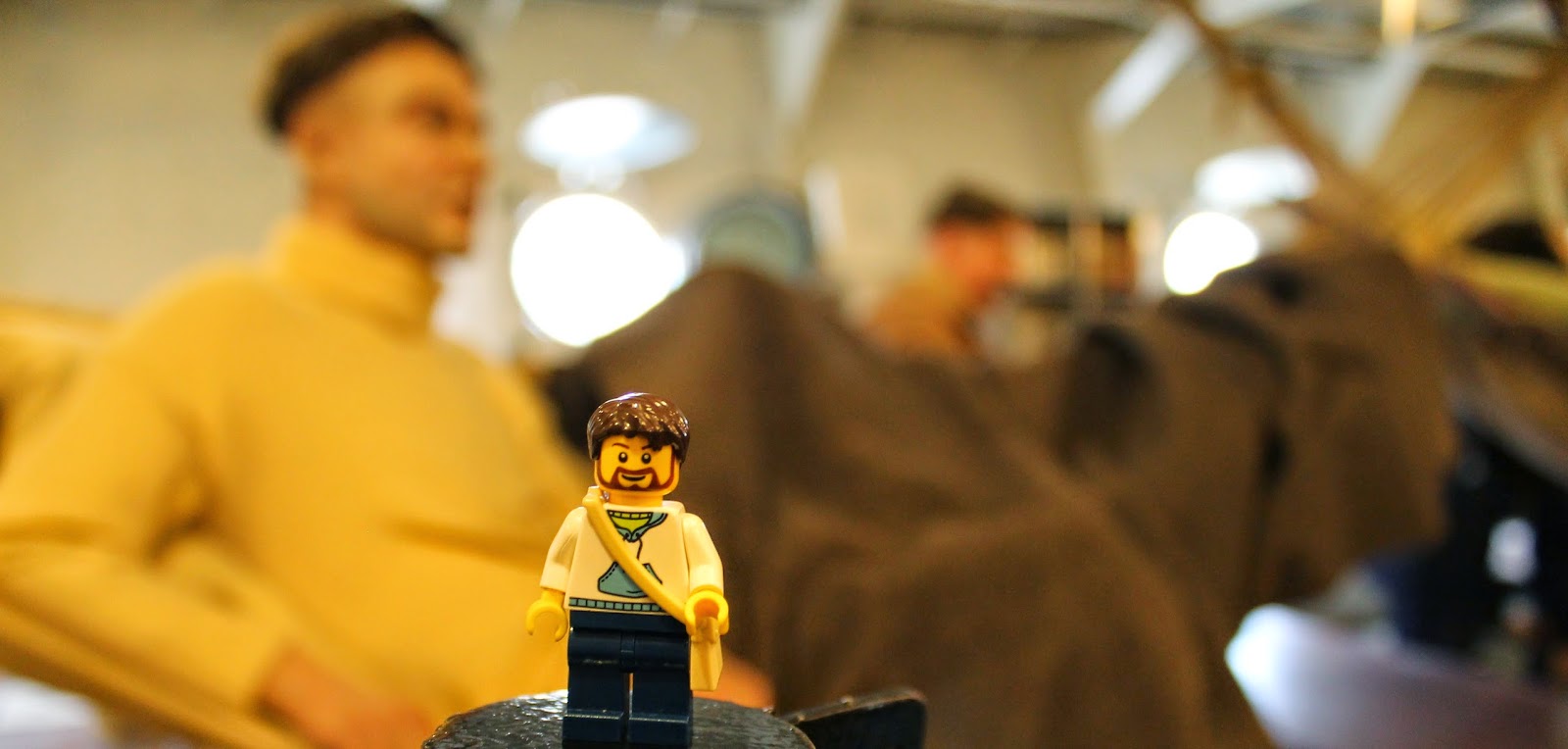
In 1900, Churchill became a Conservative member of parliament for Oldham. However in 1904 he disaffected to the Liberal Party. He became the undersecretary at the Colonial Office when the Liberal Party won the election in 1905. This setting him on the road of his political career.

In 1911, he became the first Lord of the Admiralty. He was able to hold his post in the first few months of World War One, but he resigned after being blamed for the disaster of the Dardanelles Expedition. 


Churchill then served on the Western Front for a while on joining the army. Although, by 1917, he was back in government. From 1919-21 he was the Secretary of State for War and Air, and from 1924-29 he was the Chancellor of the Exchequer.

When the World War Two broke out in 1936, Churchill became the first Lord of the Admiralty again. In May 1940, Neville Chamberlain resigned as Prime Minister and Churchill took his place. He inspired the nation with his refusal to surrender to Germany. Building strong relations with the US President, Roosevelt and maintained a difficult alliance with the USSR, Stalin.

"We shall fight in the hills,
we shall never surrender" 

- Churchill
In 1945, Churchill lost power after the war elections in 1945, but still MP, he voiced his opinions of the Cold War, giving the phase the 'Iron Carton' to the Berlin Wall. In 1951, he once again became Prime Minister. However, in 1955, he resigned, but remaining a MP until his death. 

In 1953, he was awarded a Nobel Prize for Literature because of his impressive number of publications, such as, his six-volumes of 'The Second World War'.

He died on 24th January 1965 and was the first former Prime Minister to be given a state funeral.

Wednesday, 9 July 2014

Visit to HMS Belfast with the Imperial War Museum

Lego Museums visited HMS Belfast in London on the Thames in 9th July 2014. This is a warship which was built in 1936 and launched in Belfast on St Patrick's Day 1938. She was the largest and most powerful cruiser in the Royal Navy of the time and still was for most of the War.

Will going for a close up of HMS Belfast.
It was designed for the protection of trade, was called into service to patrol the northern waters to impose a maritime blockade on Germany. Although after being hit by a mine, she was out of action for three years. 

The ship bell - HMS Belfast

After returning to the home fleet in 1942. HMS Belfast was sent to to the arctic to protect the convoys and Russia's supply route throughout the war. HMS Belfast continued to be apart of the arctic convoy until 1944 when she spent five weeks supporting D-Day landings and she was reported to have fired one of the first shots on D-Day itself.


Will loves the HMS Belfast.
After the Second World War HMS Belfast played her role in the Korean War 1950-52. She then spent her final years as a peace-keeping duties until she was retired in 1963. 

In 1967 the Imperial War Museum took her under their wing. She was then opened to the public in 1971 on 21st October. 

The way the IWM has done with the HMS Belfast is well done. All way through the warship there are a number of wax works showing that each room was used for. Including sounds of the ship that have been placed in really brings the place alive for all the visitors. Even some of the wax works move to give the visitor a strange feeling that you aren't really alone.


Will is hanging with the crew of HMS Belfast.
Postmaster I wish to gain multiple views on my post, please.
Will is wondering what is for dinner... potatoes... damn it not again!
As well as this, throughout the ship there are a number of original articles that would been used around this time and period. The whole ship is a adventure inside out. A great place to lose the kids in. A great place to go for the day out if you are interested into World War 2 and military weapons of war.      

Friday, 6 June 2014

D-Day Museum 70 Years of the Normandy landings

Lego Museums visited the D-day Museum on the 6th June 2014 on the 70th anniversary of the Normandy landings in 1944. Let’s remember those who sacrificed everything for the greater good on D-Day. Let’s commemorate those thousands who lost their lives so others may live in freedom.


Will with his D-Day 70 year's badge.

Will entering the D-day Museum.

The museum is pact with WW2 history from Portsmouth and other aspects of the Operation Overlord. Going into the museum you come across first is the large and long Overlord Embroidery, which is the modern-day comparison to the Bayeux Tapestry of 1066. This 272ft long piece of art (33ft longer than its 11th century counter-part), looks back upon the dark days before the operation of 1940 to the victory in Normandy in 1944.

The embroidery itself is worth going into the museum alone to see. Although through-out the museum there is a number of other great and interesting galleries to see.

These galleries display a large number of real artefacts for the war alongside some life-like wax works, which gives the objects a life of their own as well giving the visitor a feel of what it was like in times of war within the late 30s and early 40s. Also using their personal objects of the men who lived it gives a touching look into the lives of all who were involved, with the stories of home with the blitz to the life at the front-line in France. This museum also looks at the aspects of both sides, from the Allies and the Germans.


For those military armament fans; there are a large rang of weapons and vehicles what are dotted around the museum. This small museum is fantastically laid-out to easily show the visitors all what the museum has to offer. 

BANG!!!
Will looking out from a landing boat.

Will is driving a U.S. Jeep.

If you are a large WW2 and/or military buff you should go to the D-day Museum to enjoy what they have to offer.