Friday, 25 March 2016

Medieval Lego History book REVIEW!

Medieval Lego by Greyson.
Medieval Lego by Greyson Beights is one of the best Historic books which is illustrated with Lego I have ever read. The whole book inside and out just shows high quality in the information and materials. 

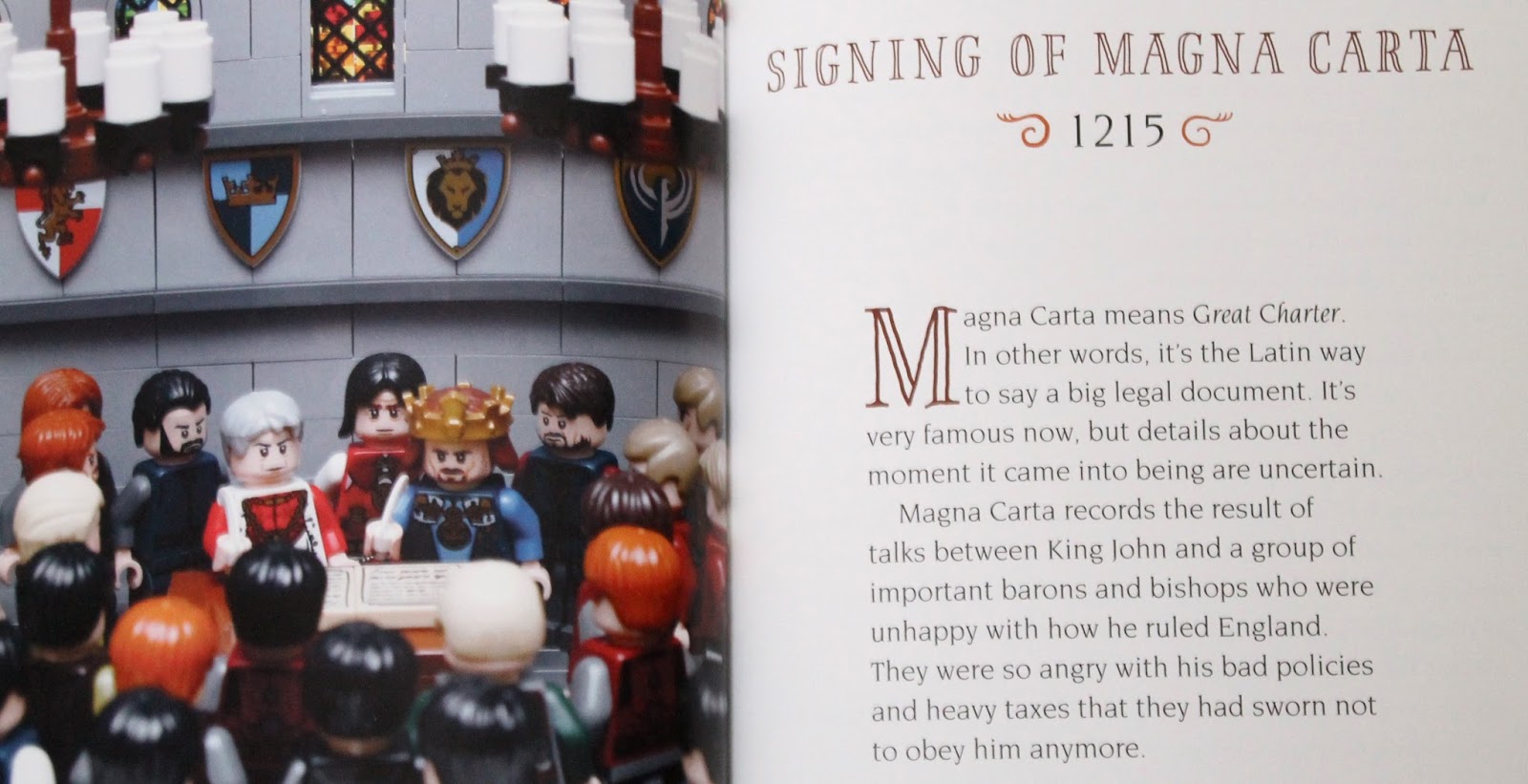
Greyson and with the help of Medievalist Scholars, created a book that looks at the overview of important events which made  the Medieval world as a whole. You'll will be able to learn about the Battle of Hastings, the signing of the Magna Carta and other great events. 

Greyson gives us a nice balance of Lego Photography and information, which you don't necessarily see in a lot Historic Lego books. Most of the time Historic Lego books give you a lot of photos with so little information accompanying them. This book however gives you a equal display of both.
  
Even the price seems generous for such a great  and small book. The only thing bad, that I can think of, is there isn't enough of it. Give me more! 

The photos themselves are great, everything you see is done in shot, as it seems there was no use of Photoshop at all. Oh and the builds that make up the scenery are amazing. Beautifully designed and built. 

Magna Carta 1215.
If you're a Lego purist then you would be happy to hear that everything in this book is Lego, no custom accessories or minifigs. Definitely a great book for both Lego and History fans of all ages.  

Saturday, 19 March 2016

The Tower - Palace and Prison


The Tower of London
- @ITweetMuseums
Originally built in 1078, and being constantly extended and rebuilt until 1399. The Tower of London is one of the most iconic historic buildings in the UK and millions of people all over the world come to visit it every year to take a look at the Royal Armouries and the Crown Jewels. 

Throughout the grounds you can visit most of the building learning the many different stages of the fortification, and the Royal palace living courtiers. Each section has the history about the building and some related artefacts displayed there.  

The main building is obviously the most iconic of the whole palace complex is the White Tower. With-in the building you will find the Royal Armouries and their long term display of the Line of Kings and their weaponry displays. 


Henry VIII armour in the
Line of Kings display.
The Line of Kings display was established in 1660 after the restoration of the monarchy in England. The exhibition was to promote the King's right to rule. 

As there aren't examples of armour for every monarch. They only displayed armour they had to hand and just added the names and dates to each descriptions. The display originally only displayed the good kings such as, William the Conqueror; no bad king was displayed but only later on they started to appear. This 17th Century propaganda was to show a continues link of good and great kings to strengthen the king's right to the crown, after such a uneasy reputation after the civil war. 

The collection was rearranged and dispersed over the years. The display today has be reassembled to showcase the history of the English monarchy and is the worlds longest visitor attraction. 


Also displayed in the White Tower is the long history of how the Royal Palace was also used in its later years as a prison and a place of execution and the history of weaponry.

The most visited attraction of the Tower is the Crown Jewels. The role of the Tower for many years was to protect the treasures of the monarchy. Even though the coronation tradition as been used for the past 1000 years, the jewels in the Tower today are quite modern. Most of the jewels in Jewel House were made in the late 1600s, the jewels before that were destroyed after the brief removal of the monarchy. 

So this is a great place to learn about the buildings and the Monarchy through the Royal Armoury and the Crown Jewels.

Tuesday, 9 February 2016

Martin Luther King, Jr. - "I Have A Dream!"

Martin Luther King
Martin Luther King, Jr. was born at Atlanta, Georgia on the 15 January 1929. Son to a Baptist minister, Martin Senior and a schoolteacher, Alberta Williams King.

In 1943, at the age of 14, King was forced to give up his bus seat for a white passenger on his ride home. This humiliating event in his life spurred him to confront the injustice of inequality.

In 1948, at the age of 15, King attended Morehouse College. Here he discovered the writings of Henry Thoreau and he became fascinated by his ideas of non-violent resistance. He was then inspired by father and college president, Benjamin Mays, a Baptist minister and advocate of racial equality. King was later ordained as a minister.

After he graduated college, King continued training at Crozer Theological Seminary in Pennsylvania and received his doctorate from Boston University School of Theology in 1995. King married Coretta Scott, a student at Boston on the 18 June 1953. Over the 10 years the couple had four children.

In December 1955, Rosa Parks was arrested in Montgomery for refusing to move from her seat on a bus so a white man could sit. King lead an African-American bus boycott that lasted 381 days. In 1956, the US Supreme Court ruled that Montgomery's bus policy was unconstitutional. 

Working with Bayard Rustin, a civil rights campaigner, King established the Southern Christian Leadership Conference (SCLC). King and the SCLC hoped to gain success in Montgomery by expanding the bus boycotts across the South. However, in some places, the African-American population was too small to make it effective. In other places, they quickly gave in on the demands of the boycott. Although elsewhere they simply allowed their bus services to go bankrupt, rather than give in to the boycotts.

In 1959, King traveled to India to learn more about Gandhi's non-violent protest movement. On his five week tour of India he met Gandhi's family and Prime Minister Nehru. He returned home determined to use non-violence in his protests. However, his non-violent protest in Albany, Georgia in 1961-1962 was unsuccessful as the police didn't confront the protesters and defused the situation by starving the cause of publicity.

In 1963, King staged a massive program of boycotting, marches and sit-ins at Birmingham, Alabama. As a result King was arrested on the 12 April. Although, at Albany, the authorities used violence to break-up protesters, using high-powered hoses and dogs. The coverage of the events won public support for King's case.

King was later released and was invited to the White House, where President Kennedy showed his support for the cause.

King made his iconic 'I Have A Dream' speech at the March on Washington for Jobs and Freedom on the 28 August 1963. There was a crowd of about 200,000 people at Lincoln Memorial and millions watching at home, as King shared his vision of the day of freedom and equality for all.

'I have a dream!'
On the 15 September 1963 a Supremacists bombed a Birmingham church and killed four girls. The was a huge public outcry at the news. At their funerals King addressed about 8,000 mourners. In the summer of 1964, Congress passed the Civil Rights Act, ending segregation in public. 

At 35, King received the Noble Peace Prize in 1964. Making him the youngest person to be awarded it.

In 1965, King started to campaign for voting rights in Selma, Alabama. After the state troops clashed with protesters at Edmund Pettus Bridge, activists around the country took part in a five day march from Selma to Montgomery. King led the group of 2,000 on the march. As they marched the grouped increased to 30,000. That August, the Voting Rights Act was passed, which removed the barriers for African-Americans to vote.

In 1966, King and his family moved to Chicago's west side black ghetto. He was trying to help the urban poor in North America. He found it hard to get the support behind his cause. Also the local authorities agreed to promote fair housing and then they went back on the promise. After this his message of using non-violence was losing support. Within many civil rights movements there was a growing support for violence. Which saw the rise of the Black Panther group. 

After his defeat in Chicago, King continued to involve himself in US economic, social and foreign affairs. On the 4 August 1967, he made a speech in New York at a march against the Vietnam War. He spoke against  the US's neglect of the poor and the waste of money on war.

In 1968, King started the Poor People's Campaign working to end economic inequality.

While in Memphis for a march, King was shot on his motel balcony by a white supremacist, James Ray, on the 4 August 1968. On hearing the news of his death, riots broke out across the country. President Johnson called for a national day of mourning.

Even though Martin Luther King, Jr. never saw his dream of peace and social equality in America, he is remembered for his beliefs, principles for non-violence, and views for freedom and equality. Today he is the only African-American to have a national holiday.  

Sunday, 24 January 2016

I Love That Minifigure! Book REVIEW!

I Love That Minifigure by DK.
With this small Lego book you receive a exclusive minifigure, a Zombie Skateboarder which is a recreation of the first Lego Skateboarder from the Minifigure Series 1. A great minifigure. Many people simply got this book just for the minifigure alone but the book is equally as good as well.

It is very similar to the Lego Minifigure Year by Year book although it looks at a smaller selection of minifigures, shows more detailed information and shows how exclusive and rare each of them are. It rates the minifigures rarity, on how many were made and how many sets had it in. Funny enough it also describes the exclusive minifigure that even comes with the book.   

Exclusive Minifigure,
Zombie Skateboarder.
Now if you aren't a huge Lego fan then I wouldn't suggest reading this, as this book is more for a Lego enthusiast and collector as it isn't a book for a light read. This book would be extremely useful for anyone who collects minifigures and wants to know information about their collection or to see which ones they might not have. 

Monday, 11 January 2016

Lego Minifigure Year by Year - A Visual History Book REVIEW!

Lego Minifigure Year by Year
by DK
With this very large book, official Lego book by DK, you receive three exclusive minifigures, a plain Townsperson, Stormtrooper and a Robber. The minifigures aren't really that special, I wouldn't advice anyone getting the book just for the minifigures alone. They wouldn't be worth it. Although the book is, as long as you have a huge interest in Lego minifigure. 

You can learn the history of the Lego minifig, how they are made and how they have evolved to the little yellow figures we know and love today. As it shows in the name of the book it goes through each minifigure year by year. Telling you different information about each one. It even touches on the elements that makes up each minifig, such as, the different hats and hairpieces they may use.

Exclusive Minifigures, 
Townsperson, Stormtrooper 
& Robber     
Now if you aren't a huge Lego fan then I wouldn't suggest reading this, as this book is more for a Lego enthusiast and collector as it isn't a book for a light read. This book would be extremely useful for anyone who collects minifigs and wants to know information about their collection or to see which ones they might not have.