Monday, 12 February 2018

Lego Classicist

Lego Classicist Logo
Lego Classicist is social media page which is dedicated to recreating classicists in Lego. Started up by Liam D. Jensen (Independent Historical Archivist) takes a interesting approach to history and Lego. 

Although every thing has a interesting beginnings. Lego Classicist started  up by  completely accident. During Liam's holiday break from work, he happened to be look online for Lego and stumbled across a number of figure parts that reminded him of Associate Professor Tom Hillard, an academic and an old family friend. He purchased the parts, thinking it would make a great gift.


The first Lego Classicist,
A/Prof. Tom Hillard.

Liam uploaded a photo of the figure on his personal Facebook account. The post became popular and found it's way across Australia.

After making more Lego figures for other academics, the hobby jumped started Lego Classicists.

The Lego Classicist family grow and now includes former Lego Senior Curator at Nicholson Museum Michael Turner (responsible for three Lego models displayed at the Nicholson Museum), Lego Prof. Wallace-Hadrill (Roman historian, archaeologist and TV presenter), Lego Dr. Kara Cooney (world renowned Egyptologist and presenter), Lego Sir Charles Nicholson (founder of the Nicholson Museum, University of Sydney) and Lego Prof. Christopher Smith (Director of the British School at Rome). 


Former Lego Senior
Curator at
Nicholson Museum,
Michael Turner
"The goal of these Lego Classicists figures is more metaphorical art than literally correct visual truth... so then the real challenge is not to make them 'look' like the person, but how to make them 'feel' like the person"
- L.D. Jensen

Every Lego figure made by Lego Classicistic are gifted to the people they portray and are never produced for commercial profit because every single figure to be unique and special to the person who are honoured in Lego Classicists. 

To qualify as an Lego Classicists, you need to come under the three categorise: 

Lego Sir Charles Nicholson
founder of the
Nicholson Museum
Lego Classicist
Anyone who deals with any other serious study of the ancient world of any other civilization across the world, such as Egyptology.

These include academic, scholar, archivist, librarian or historian who works in the study of classics (the ancient worlds of Greece & Rome, traditional classics) can become a Lego Classicist.


Honorary Lego Classicist
Anyone who works in the discipline of history, including modern history, who is promoting the greater use of the recording and use of history.

Anyone, including people outside the discipline of ancient & modern history, who has shown great interest in, or provided a significant new perspective to, the study or understanding of ancient history.

Me in Lego
by Lego Classicist
Honourable Mention Lego Classicist
Anyone who has had a connection to the work of ancient world study and engagement, even when their work is seemingly unconnected, but without whose help it would not be possible.

Lego Classicist reminds me a lot of myself, with my Lego historic people posts and photographs. I completely respect Liam for providing Lego figures for free in honour of those in the cultural sector.

Find out more:

Thursday, 23 November 2017

Lego Architecture - The Eiffel Tower

The Eiffel Tower
The Eiffel Tower is the most iconic structure in Paris, France. Named after the engineer, Gustave Eiffel, whose company designed and built the tower. 

In 1889 was the 100th anniversary of the French Revolution and Paris hosted a World's Fair to mark the occasion. Three years before, there was a competition to get a centrepiece for the exhibition. Gustave's plan for 985-foot tower won.   

The tower was a success with the public. By the end of the 1889 World's Fair, there had been nearly two million visitors. However, Eiffel only had a permit for twenty years; it was due to be dismantled in 1909, as the ownership reverted back to the city. The city was going to take it down, but Eiffel argued that the structure was valuable to communication and scientific purposes. '...not only the art of the modern engineer, but also the century of industry and science in which we are living' - Gustave Eiffel. After the short campaign, it was allowed to remain. 

Gustave Eiffel 
1832-1923
Eiffel installed a meteorology lab on the third floor and later constructed a wind tunnel at the foot of the tower. He carried out thousands of tests there and saw many others uses the tower to study meteorology, astronomy and physics.

The tower was home to the original wireless telegraphy which secured it's future. The top of the tower has been modified to a growing number of antennas. Now its now home to over 120 antennas plus a television mast making the tower 1,063 feet taller. 

Today the Eiffel Tower remains one of the most recognizable structures in the world, seeing estimated seven million people through the doors each year. 

The building of the Eiffel Tower

Saturday, 30 September 2017

The Art of the Brick - A Life in LEGO by Nathan Sawaya - Book Review.

The Art of the Brick -
A life of Lego by Nathan Sawaya
Now I do have to admit the biggest sin of them all, I missed my chance to go and see the amazing The Art of the Brick exhibit when it was in London. I regret not going. After seeing on-line images and reading this book by the artist Nathan Sawaya, just makes me feel worst about it. With a growing interest and artist fascination with the simple brick; the art world has grown bigger and bigger with more artist coming out of the wood work.

Now in my opinion Nathan is the best Lego Sculpture artist I have ever seen. Using only a simple brick to create these beautiful sculptures. From up close the sculpture is blocky and pixilated but from a far the piece seems smooth and realistic. Allowing the artwork to change perspective of the item from different distances.

Nathan creates a miscellaneous types of sculptures. Some a recreations of day-to-day items (for example, apples a dog), artworks (for example, The Kiss by Gustav Klimt) and a number of unusual modern art human sculptures (for example, Yellow). Some of these sculptures are actually featured in the book.

Looking at the book itself, is a high quality book. The book is full of amazing images of each sculpture which is described on every page. The great thing about this book, is how its written by the artist himself; rather than a critic who describes what he thinks of each art work depicted. Doing the book this way allows the reader to get a glimpse in the world of the artist and the inspiration behind each piece. Giving you, the reader, a personal perspective and the true idea behind the art, rather a false interpretation of someone else.


MOC inspired by
Nathan Sawaya
Okay you might be saying 'why don't you like art critics opinions?' That's not what I am trying to say, they all have valid opinions and art is there to be interpreted. Each view of a piece of art will be in fact different and comes from how the viewer feels about the art work in question. Art is there to be bring out those emotions and ideas. Although it can be far more interesting to learn the inspiration of the artist and their intention of the piece itself. For example, one may look at Yellow a say, it about a broken heart. The gapping whole of what was once there when they were loved. Which is completely valid; although Nathan, the artist, will say its a person opening their true self to the world without fear and how this has shown in his own life experiences. So the explanation by the artist can be more valuable than others as it gives you more of an insight.

Well then would I suggest to you to get this book? Yes, would be the simple answer. If you are a fun of Lego and/or art then don't hesitate to get this book. This book is valuable as it give you a insight into the world of the artist, Nathan Sawaya and his fantastic pieces of art he loves to create. Getting this book will be the most fascinating thing you will do today.

Saturday, 24 June 2017

The Lego Architect Book Review.

The Lego Architect
by Tom Alphin
Ever since the creation of the plastic brick in 1949, building creation and recreations out of the interlocking brick system has fascinated fans for generation. So it's not surprising it has branched out to architecture. Seeing many beautiful creations of buildings using many interesting techniques of Lego building to recreate these iconic sites. With this interest saw the introduction of the product series by Lego with Lego Architecture in 2008 and onwards.

This book by Tom Alphin, takes a look at the many different types and techniques of architecture and Lego creations. In each is a reasonable length of description on the history and definition of the type of architecture which is used. The interesting aspect of the book is the inclusion of building tips to help with creating your own model. I have never personally seen this in any Lego book before and I do wish to see more of it in more variety of Lego subjects. 

The Prairie House model
After the definition a number of amazing Lego model recreations by other great Lego builders which relate to this type of architecture that's mentioned.

After this there is a section to build your own little model as Tom Alphin has designed some great small Lego instructions to follow. Unusually the models you can create only uses one colour, white. It is interesting why he may have used a single and plain colour; as he might have been referring to architect design models which are normally used by architects to show and display their designs before it is built. 
The uses of the white can also be very helpful on obtaining the parts you need to build the models as a great source of this would be the Lego Architecture Studio set. However, not all the parts you need are in the set. Although using the Studio is most likely the easiest option you will still need to get a few additional pieces especially if you wish to make all of the models in the book. If you wish to do this I would advise to get more than one Lego Architecture Studio set.


The Art Deco

Movie Theatre model
Overall the book is interesting and full of information and Lego ideas to think about. The book is a beautiful addition to your bookshelf and a interesting read to past the time with. If you like the Lego Architecture series, architecture or architectural history. Worth a buy. 

Tuesday, 21 February 2017

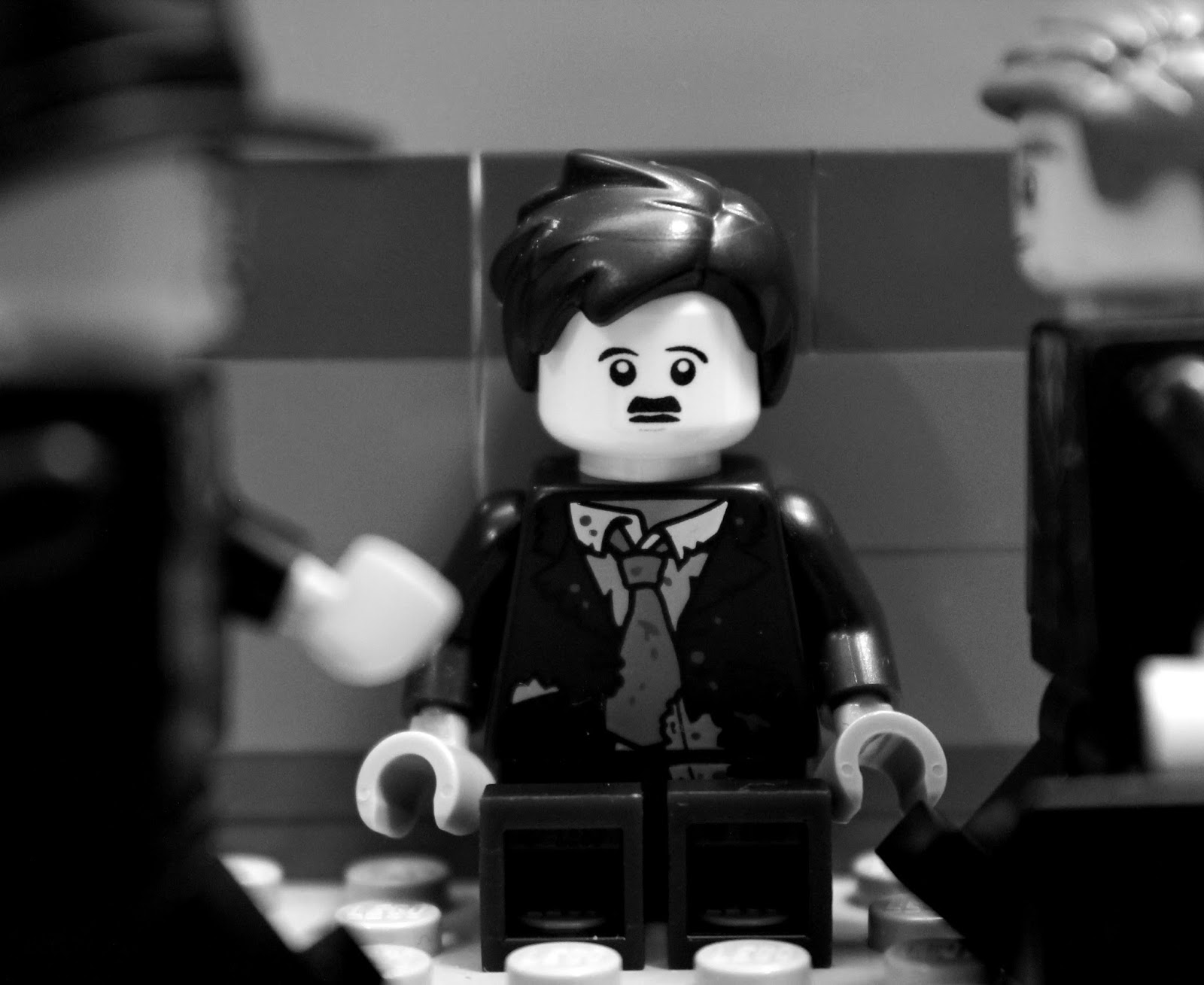
Adolf Hitler - The Monster and Tyrant

On the 20th April 1889 Adolf Hitler was born in a small town in Austria, Braunau am Inn. His father, Alois was a customs official while his mother, Klara, came from a poor family. Alois was a overbearing man and Adolf frequently found himself the wrong side of his anger. Adolf left school with no qualifications at 16. 

Hitler always dreamed of a career as a artist. He applied to the Vienna Academy of Fine Arts but was rejected in October 1907. He then moved to Vienna after the death of his parents and spent his time there sleeping in hostels and painting postcards. Here he developed many of his views of anti-semitism and desired to unite Germany and Austria.

Hitler in Vienna selling postcards
as a failed artist.
In 1913, Hitler moved to Munich to avoid military service. He loved Germany and wanted to prove his loyalty. In August 1914 he was given that chance, Hitler enlisted in the German army to be party of the Great War. He served in both France and Belgium, where he was decorated twice for bravery. In 1916, Hitler was wounded at the Somme. Then in 1918, he was wounded a second time after a gas attack. While in Pasewalk, Germany surrendered. The Kaiser Wilhelm II abdicated days before armistice and many of the members of parliament were given poisoned chalice. 

Hitler and many others were angry by what they saw as a betrayal by the Jews and the socialists at home. In June 1919, the Treaty of Versailles was signed and Germany were forced to accept sole responsibility for the war. As well as this, Germany had to pay a large amount of reparations and huge chunks of their territories were divided among the victors. Again like most, Hitler hated the treaty. He then decided to go into politics by joining the Germany Workers's Party (later known as the Nazi Party). Hitler completely agreed with their Nationalist and anti-semetic beliefs.


Hitler doing one of his
many hateful speeches.
Using his oratory skills, Hitler raised through the ranks of the Nazi Party. In February 1921, he spoke before 6,000 people in Munich.

Anton Drexler, founder of the Nazi Party, became unsettled by Hitler's popularity. He formed an alliance with a socialist party while Hitler was in Berlin. Drexler's attempt to undermine Hitler failed as he resigned and rejoined only when he was given control of the party in July 1921.

In 1923, the German Government was at the edge of collapse. The economic situation of the country was worsening as inflation increased. By that year a loaf of bread raised from 250 marks to 200 billion.

Wishing to see Germany to be great again under his control, Hitler encouraged revolution. On the 8th November, Bavarian Prime Minister Gustav Kahr addressed a collection of businessmen at a beer hall in Munich. Hitler and a load of his SA soldiers stormed in and forced Kahr to pledge his support. The next day Hitler led 3,000 men into the streets. However the police were waiting for them. Violence followed which resulted in the deaths of 16 Nazis and 3 policemen. Afterwards Hitler was arrested and sentenced to 5 years in prison for treason.


Hitler in prison writing
his book, Mein Kampf.
Within the 9 months of imprisonment in Bavarian fortress of Landsbury am Leck, Hitler spent his time writing his book, Mein Kampf. Mein Kampf outlines Hitler's views of the superiority of a white Aryan race and his cruel perspective for the Jews. He also describes Germans prosperity under Nazi control, for example, military expansion, elimination of the "impure" races and dictatorial authoritarianism. It was published in July 1925.

After being released he hoped to be elected. However, in 1928 the Nazis only won just 2.6% of votes.

Although, after the American stock exchanged collapsed in October 1929 and the foreign loans on which Germany relied on were stopped and repayment was called in. Unemployment rose to 6 million and parties on both sides saw support increase dramatically. That same year Hitler met 17 year-old Eva Braun, a German Catholic girl.

Hitler led the Nazis to become the largest party, with over 37% of the popular vote in the elections of July 1932. President von Hindenburg was concerned about the Communist's growing support. This persuaded him to give Hitler the post of Chancellor in January 1933. By March he was given dictatorial powers from the Enabling Act. This allowed him to pass laws without the Reichstag. Other Political parties, organisations and unions who were associated with the Nazis were disbanded.

The Army leaders were concerned with the SA who has helped Hitler to power. SA was considered as a group of thugs and Hitler needed to separate himself from them. In June 1934 the leader of the SA, Ernist Rohn and hundreds were assassinated in one night. This was to become known as the The Night of the Long Knives. Hitler couldn't tolerate opposition to his plans to suppress workers rights and make Germany ready for war. The army approved of his plans and when President Hindenburg died in August, they supported his promotion to Fuhrer.


The "Final Solution"
(the Holocaust) saw the death of
6 million Jews.
Since 1933 the Nazis had excluded the Jews and other "undesirables" from the public life. However, in September 1935, at the Nuremberg rally Hitler announced laws denying Jewish people citizenship and to marry or have sexual relations with people with German blood or decent. Hitler characterized the laws as an effort to achieve the "final solution". Under the new laws, Jews became targeted for persecution and was the direct course of the Night of Broken Glass. In November 1938 many Jewish residents and shops had their windows smashed and some were burnt down. Around 100 Jews were killed and thousands were arrested. From this time and on-wards huge numbers of Jews were around up and taken to concentration camps. Until the end of the conflict in 1945 over 6 million Jews were murdered within these camps by the SS. 

Hitler wished to see Germany great again and territorial expansion was part of achieving this. In March 1938, Hitler led his Nazi troops into Austria, achieving his dream to unify the two countries. Main countries, like Britain and France ignored Hitler's invasion at a attempt to prevent war. In September Neville Chamberlain (British Prime Minister) organised a conference in Munich and here all of Hitler's demands for Germany empire expansion was granted. Later that year Nazi troops marched into Czechoslovakia and took Sudetenland.


Hitler the looked east to Poland. Although before he could do anything he had to make a deal with Stalin's USSR. In late August 1939, the two powers agreed to a non-aggression pact. On 1st September the invasion of Poland began. Hitler was confident that Britain and France would not retaliate to help Poland. He was wrong, Britain and France declared war on 3rd September.


Poland was soon taken by Germany. Hitler's Blitzrieg tactics allowed the German army to take countries with a brutal single stroke. 

On 17th June 1940, France surrendered allowing Hitler to take revenge for the German defeat from two decades ago. Hitler ensured the French submitted at Compiegne in the same train carriage Germany had been forced to sign the Armistice which ended the First World War.


Churchill, Roosevelt & Stalin
making a alliance agreement. 
Despite the Nazi/Soviet Pact, Hitler hated the communists. Hitler was growing extremely suspicious of Stalin. Hitler planned to defeat and invade Western Europe before turning on the Soviet Union. However, when Soviet troops marched into Baltic States in 1941, Hitler decided to turn on them and invade the USSR. Hitler believed the Red Army would be defeated in a few months. He was wrong and to make it worst he declared war with another supper power, the US.

Hitler took control of the operations of the army in the Eastern-Front, convinced he was the only one to make the invasion successful. He directed the army from his headquarters which was thousands of miles away from the action. However, in February 1943, at Stalingrad, the German forces could not hold the city as they were outnumbered, freezing and starving. Hitler blamed the officers on the ground for ignoring orders. As he was the main person in command of the troops, he saw criticism for the first time because of the defeat.

Germany was losing control of the Eastern-Front. German forces retreated from Russia and in June 1944, the Allied forces landed in Normandy on D-Day. Hitler saw the invasion as a good thing and believed his forces could take the US and Britain out of the war.


The Wolf's Lair after
the 20th July Plot (Operation Valkyrie)
With the major turn of the success of the war was in favour of the Allies, many of Germany's loyal commanders now wanted Hitler dead to end the war for good and save lives. Hitler became increasingly paranoid as he had already had five attempts on his life. On 20th July 1944, saw the closest one yet. Hitler met with his military leaders at the Wolf's Lair Headquarters. Lieutenant Colonel Claus von Staufferberg left a bomb in a briefcase in the conference room. The blast killed three officers. However, Hitler escaped with minor injuries as he was shielded by the oak table which took much of the force of the explosion.  

In April 1945, the Soviet army were close to Berlin. Hitler excepted defeat. So he married Eva Braun, who had been his girlfriend for the last 11 years. They got married on the 29th April. The next day they both took a cyanide pill. Hitler then shot himself in the head. Their remains and two dogs were later discovered in his bunker by the Red Army. 

Thursday, 2 February 2017

World War 1 Lego/3D Printed book review

World War 1 
by Minifig Battlefields
I have been looking forward to a Lego book about Great War. I was hoping for great photos, amazing builds and interesting content. However with this book by Minifig Battlefields, I wasn't so happy about. I would love to say a lot of good things about this book but I can't, sadly.

The most interesting thing about this Lego book is how it uses 3D printing and Lego to illustrate the history. This isn't a bad thing but there isn't much Lego to be really seen in the entity of the book, apart from the minifigures. I understand that the company mainly sells and uses 3D printed, WW1 military Lego parts and this is another branch of the same thing. However, this gives the book a catalog feel to it, a way of advertising their products. Making the book not much of a Lego one.

The information is the only real good thing about this small book. Its interesting and accurate, and goes through all aspects of the war from the famous of battles, to the uniforms and weaponry each country during it. 

Page layout.
Overall the thing which destroys the entire book is the photos. Most or not all are green screened and badly photo-shopped creating what could have been a great image to something which could have been done better. The worst thing is, a few of the images are ever out of focus or been enlarged making it extremely pixilated. 

Its a shame how a standing idea of the book was great the execution of the book could have been so much better and more perfect in the way it was presented.    

Saturday, 5 November 2016

Guy Fawkes - 'Remember, remember the Gunpowder Plot'

Guy Fawkes being arrested in 1603.
Guy Fawkes was born in April 1570 at York. He was brought up in a family and country of Protestants. However, he was Catholic and refused to attend Protestant services.

At the age of 21, Fawkes sold his estate and went to Europe to fight for Catholic Spain against the Protestant Dutch. In 1603 he was made captain. That same year he appealed to King Philip III of Spain to support a rebellion in England against James I. Philip refused to give his support.


While fighting for Spain at Flanders, Fawkes meet Thomas Wintour, who asked him to join a plot which would become known as the Gunpowder Plot.

After 18 months of planning, the plot failed when Fawkes was arrested at midnight on 4 November 1605 under the Houses of Lords. With him they found 36 barrels of gunpowder was found in a cellar directly below where the King would have sat to open Parliament the next day.

He was tortured for two days by James I's spymaster, Robert Cecil. After which, Fawkes confessed to it all. He was then sentenced to death - to be hanged, drawn and quartered. However, he jumped from the gallows, breaking his neck and so avoiding the horror of being cut down while still alive, having his testicles cut off and his stomach opened and his guts spilled out. His dead body was then hacked into quarters and his remains were sent to four corners of the Kingdom to serve as a warning.

Sunday, 25 September 2016

Google's Art & Culture - Online Galleries

Now Google's Art & Culture is an really interesting and probably is the biggest of the on-line museum and art galleries catalogs out there. Maybe, because Google is a billion pound company or as they have started this project a long time ago and they have built it up to what it is today from there. Now I am not going to take a look at all about this amazing site has to offer, as this would be like reviewing the internet itself, a impossible task.

When the Art Project first started in 2011, the site had a huge collection of scanned works of art. For the first time you could take a close look at works of art and learn about the pieces; and the artiest who made them. You could see the artist brush strokes and the detail of the art work which you might have never been able to do at a art gallery. The project has evolved and now you can do and see so much more. 

At the moment I believe the site is a beta test and might be changed or updated to something even better than what's up at the moment but I see this as really unlikely.

You can take a look at articles, artefacts, art work, museum collection, Google Earth drop-in historic and museum/art galleries; historical accounts on events, people and so much more. 

Now with the artefacts, art work and museum collections you take a close look at individual objects with high detail. The site allows you to look close to objects for the first time. This makes you feel like you are looking at the object face-to-face or with a magnifying glass. Allowing you to see everything from the artist's brush strokes to every tiny detail.

Now there is a fabulous section of the site were you can digitally drop into a historic locations or museum/art galleries. In the same style as the drop-in setting of Google Earth, this allows to take a virtual tour of the location. This gives you idea of what the place it like and also allows to take a closer look of the highlights of the exhibits, giving you a taster of what you can see.

Now I could go on and on about this site as there is so much of it to take about.

The whole site is amazing. However, the only thing that I can say which is bad is the size of the collection they provide you. Now to many that's not a problem and it isn't but it is a problem if you can't search through all which they have. For example you have 1,692 of them. You get a search engine to search things, this is great if you know what you are looking for. However, can't possible know what they have to offer if you don't know and you are simply browsing. In my opinion it would be far easier with a filter system allowing you to select specific theme, century, topic etc. In the way they provide you, you would need to sieve through all what they have to find something you wish to take a look at. The other problem is the search engine itself as if you spell anything wrong, the search engine will not recognize it or give you alternatives search. So at the end you will turn up with your search with practically nothing.


Although it has some problems I must give Google a huge amount of credit. This site is what museums should inspire to with their own on-line catalog or gallery. 

Thursday, 15 September 2016

My Build: The Face

'The Face' was something that was a first for me to do, a unplanned build and with no real design what so ever. The build was originally inspired by Nathan Sawaya's amazing Lego artwork, such as many of his builds at 'The Art Of The Brick'. 

Very much unlike this model, Sawaya's artwork is planned, only builds with simplest parts, such as 2x4 or 2x2 bricks and also uses a uniform colour. Now this model was built up of anything I had to hand which seemed to make the build structurally sound. 

As you can see the model is made up multiple amount of colours from Lego's palette. What might not be obvious is that I used a lot of different types of bricks to create the model, these included, corner, technic and slopped bricks, etc. 

The whole thing is hollow but to keep some of the structure together there are some technic beams to hold a lot of it all up.

I don't know about you but I think as a first try at sculpting with Lego, that bad. I might later on build another out of one colour, like Sawaya. You never know it might even look 10x better than this one.

Monday, 29 August 2016

Brickmania Tiger I Ausf. H Review

The Tiger I Ausf. H German Heavy Tank by Brickmania is a black box edition, a large, detailed and extremely limited kit. Amazingly designed by the leading designer and owner of Brickmania, Daniel Siskind. 

This is a huge kit has equal amount of detail throughout the model. I would say this kit is very accurate to the original vehicle and is up there with the best of the Brickmania kits.  

The instructions are displayed in a high quality booklet. Right at the front of the booklet you have the history of the tank, with images of the real thing. The step by step stages of the build is very easy to do and understand. The booklet itself is better than those provided by Lego with their own kits.


This kit only comes with one exclusive Panzer officer minifigure and one Brickarms' MG34 .

The kit comes with two types of stickers to allow the builder to choose what type of Tiger they want to have. You can have to choose for a Schwere Panzerabteilung 501 or 502.

The stickers are of high quality and not likely to peal off anytime soon. In someway I would say the stickers are better then those done by Lego.

However there isn't just stickers in this kit. You get two of these exclusive printed 1x1 round tiles for the exhausts of the engine.


As I said before you also get interior details which you don't normally get in Brickmania kits. You only get these sort of detail with a black box edition. You get seating for the driver and the gunner. On top of this all of you get the engine located at the back of the tank.

What you also don't see often in smaller kits is suspension. This is because the way to do this at a smaller model is really hard to pull off. With a large model the technique to do this is able to be put in as there is enough space to do so. 

 The only problem I can find with this kit is there are some weak-points which you sometimes get with Brickmania's kits. However, as I normally say to get this type of detail you have to sacrifice stability to achieve accuracy.    

The historical kit comes to $395/£301.60 and it is worth every penny. I have to say that the Brickmania black box edition kits are always expensive but are the most detailed and high quality item which Brickmania produces.

Wednesday, 17 August 2016

The Weirdest Museums!

A few weeks ago I went into one of the most weirdest museums I have ever laid my eyes on. Now this inspired me to go and find out more about other really weird museums that might be out there. Surprisingly there are a lot. However, there was nothing on the one I went to, the National Poo Museum. Yes you read correctly, a museum about Poo. Now I will go into what they actually have on display and other weird museums below.

The National Poo Museum
Sandown, Isle of Wight.

Now they don't have open excrement simply placed on a shelf for you to examine, they aren't that weird. Each donation which the museum has is clinically displayed within a transparent plastic globe to preserve the specimen in its natural state. Now you can see a wide range of excrement, from human baby to lion. But be sure not to miss the cat poo in a kid's shoe.

Icelandic Phallological Museum
Reykjavik, Iceland.

This museum is the home to 215 penises and other peniles of most of the land and sea mammals found in Iceland. Now if you think I am joking about this, you couldn't be more wrong. But do take a look at their range of items, from the blue wale to mice. The subject matter of the museum is unusual and strange, the museum itself is totally serious. In entering you will be able to learn all about the world of Phallology, the study of penises, and their place in history, art and society. 

Currywurst Museum
Berlin, Germany.

The Germans love their sausages so why not have a museum dedicated to the Currywurst. At the ketchup-red museum display is a multi-scenery exhibit allowing the visitor to experience the sounds of sausages sizzling and smell exotic spices as they go around the rest of the museum. The museum has even recreated a food cart so visitors can go in and imagine making their favorite snacks. 

The Museum of Bad Art
Brookline and Somerville, Massachusetts, USA.

The only museum dedicated to celebrating bad artwork in all its forms. Why go to see quality art when you can see terrible pieces of art which some people may relate to or make them feel talented. As you walk through the galleries you will see artworks with clashing colours, out of proportion figures and lack of talent. So if you are feeling down about your art course, or even think you aren't good enough to make it as artist, then just spend a day here and you'll never worry about it ever again.

Parasite Museum
Tokyo, Japan

This museum is home to over 300 varieties of parasites including a 30 foot tapeworm. On top of this the museum has set up a scientific research center to study the small and the huge of the parasitic world. You might very eat or go to exotic place ever again but at least you will learn something about these disgusting critters. 

Sulabh International Museum of Toilets
New Delhi, India


This museum looks at the entire evolution of the toilet throughout history. The museum as been able to trace the toilet back through history till 4,500 years ago. You'll be able to see all, from chamber pot to Victorian toilet seats. In this museum even the rest rooms are in someway a exhibit.

Museum of Funeral Carriages
Barcelona, Spain


This museum is a basement at the city's Municipal Funeral Services. Here visitors are taken to the dusty basement by a security guard. Down there you can make your way around the exhibit's ornate carriages, some of which date back to the 18th century.

Hair Museum
Avanos, Turkey


This museum was created by Chez Galip, in rural Turkey. The museum is home to his huge collection of more than 16,000 women's hair samples. To make things even creepier the museum is located in a small, dark cave. Don't worry they let you keep your hair on.

Paris Sewers Museum
Paris, France
 
When I say sewers museum, I mean a museum in the sewer. Paris has a network of tunnels were visitors are introduced to the world of sewage disposal from the 13th century drainage systems to the first closed sewers in the late 19th century. Guides talk about the history of keeping Paris clean and for the stronger stomached  visitor you can have a walking tour of the tunnels.

Museum of Broken Relationships
Zagreb, Croatia
 
This museum is revolve around the concept of failed relationships and their ruins. Visitors are welcome to add to the collection with their own experiences and gifts from broken relationships. The artifacts include rings, clothing, Valentine's Day gifts and the occasional fuzzy pink handcuffs. However, I wouldn't go with you other half, as they might just contemplate on the relationship they are already in. 

International Cryptozoology Museum
Portland, Maine, USA
 
Cryptozoology is the study of hidden animals and search for animals who haven't had their existence proven yet. These include Bigfoot and the Yeti. The collection includes specimens and artifacts which relate to mythical creatures. These are hair and poo samples, and native art which supposedly  support the idea of the existence of the creature. Who knows they might even convert you to a believer. 

Museum of Witchcraft
Cornwall, England

Did you know that Cornwall is the home to the largest collection on witchcraft. The museum has categories of everything from devil worship and satanism to the persecution of witches. Visitors can see dipping chairs used to 'prove' a woman was a witch and voodoo dolls, which were used to inflict pain on others. Along side all of this, the museum has a library of over 3,000 books on witchcraft. This is especially great if you are thinking of taking up the art of witchcraft, so this museum is a great starting point for you.

Museum of Medieval Torture Instruments
Amsterdam, Netherlands

This museum is home to over 100 torture devices with the exhibit dedicated to the history of human cruelty. Which is a bit unsettling. The gruesome displays include a guillotine, stretching tables, screws to crush fingers, head and other parts of the body and the Judas chair, a chair of nails. However, the museum does advertise a serious message on that there are executioners still being employed and the death penalty is still exists in many countries around the world today. 

Dog Collar Museum
Leeds Castle, Kent, England

The museum is home to over 100 dog collars. These include a range of different dog collars spanning from five centuries, these include strong collars designed to control haunting dogs, to the fashion item of the 21st century collar. So this is a interesting museum for all dog lovers alike. 

Ice Cream Museum
Los Angeles, USA

Saving the best to last is one of the delicious museums I have ever heard of, the Ice Cream Museum. A brightly coloured environment where your imagination can go wild. From giant ice lolly and jelly bears art work to a pool of sprinkles you can mess around in. The museum's goal is to bring people together and think they do it well, with their exhibits help people have fun, be inspired and gain amazing new memories. Might be on the list of weird museums but should also be on the list of best and awesome museums you must go to.